If you grew up in India, you must understand the low voltage and flickering lights during peak hours. In that scenario, we often start relying on an inverter or a generator.
And this is how the rising electricity bill becomes an everyday conversation at the dinner table.
That’s the gap a hybrid solar power system is designed to address. Unlike a conventional on-grid setup that primarily works with the utility grid, a hybrid system combines solar generation, grid electricity, battery storage and intelligent power management.
But is a hybrid solar system actually worth the additional investment? How much battery capacity do you need? We have answered every detail you need to know about hybrid solar systems.
Keep on reading!
What Is a Hybrid Solar Power System?
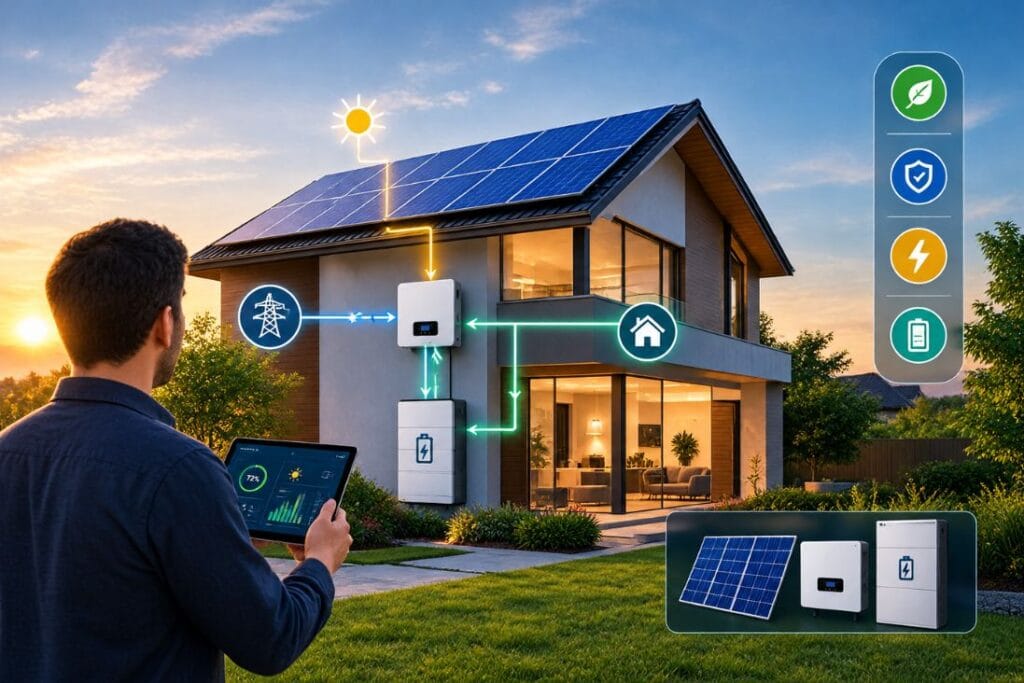
A hybrid solar power system combines solar panels, a hybrid solar inverter, battery storage and the electricity grid into one coordinated system.
During daytime, when the sun is at its peak, solar panels, especially N-TOPCon Bifacial systems, generate electricity. The appliances run using that power and the excess generation charges the battery. The system can also draw from the grid when solar production is insufficient.
Think of the hybrid solar power system as having three electricity sources working together:
Solar → Battery → Grid
The system is capable of automatically managing where your electricity should come from based on solar production, battery storage, household demand and grid availability.
How Is a Hybrid System Different From a Conventional Solar Setup?
The biggest difference between a hybrid solar system and a conventional solar setup is energy storage and backup capability.
A basic on-grid solar system can generate electricity from sunlight and work alongside the grid. But it generally shuts down during a grid outage for safety reasons.
A hybrid setup adds batteries and a suitable inverter, allowing you to store & use solar energy when the grid is unavailable.
The side-by-side comparison below may help you understand better:
On-Grid vs Hybrid Solar System
Feature | On-Grid Solar | Hybrid Solar |
Solar panels | Yes | Yes |
Grid connection | Yes | Yes |
Battery storage | Usually no | Yes |
Power backup during grid outage | Generally unavailable | Available with suitable configuration |
Excess solar storage | No battery storage | Yes |
Initial investment | Generally lower | Generally higher |
What Is a Hybrid Solar Inverter?
A hybrid solar inverter is the control centre of the system.
While a conventional inverter converts electricity from one form to another, a hybrid solar inverter performs a broader role. It manages solar generation, battery charging and discharging, grid interaction and power supply to connected loads.
Benefits of a Hybrid Solar Inverter
- 24/7 power backup with auto switch to battery power
- Cuts electricity costs by 40% to 90%
- Smart electricity priority: loads first, battery charge later
- Reduces reliance on traditional utility power
- Allows easy expansion of battery banks in the future
Solar Hybrid System with Battery & Battery Capacity
A solar hybrid system with a battery combines solar panels, a utility grid connection and a battery bank via a hybrid inverter. It ensures continuous delivery of power and backup during outages.
Solar Battery Backup System
The battery backup depends on battery capacity and the appliances you want to operate.
For instance, a battery might be able to run several lights, fans, a Wi-Fi router, a television and a pump. But adding high-consumption appliances such as air conditioners, commercial machinery, and equipment can strain the system.
How Does a Hybrid Solar System Work?
Step 1: Solar Panels Generate Electricity
Solar panels convert sunlight into DC electricity. A solar inverter then converts this into usable AC electricity for household and commercial appliances.
Step 2: Solar Power Runs Your Loads
The electricity generated by the panels is first used to power connected appliances such as lights, fans, refrigerators, computers, pumps or other loads.
During sunlight hours, solar generation may be higher than your immediate consumption. If the generation is sufficient, the dependence on the grid is reduced.
Step 3: Excess Solar Charges the Battery
When solar production exceeds immediate consumption, the surplus can be directed towards the battery.
This is one of the defining features of a solar hybrid system with a battery.
Step 4: Stored Energy Is Used When Required
Once solar production drops in the evening or during a power outage, the battery can supply electricity to designated loads.
That’s where a hybrid system becomes particularly useful for homes and C&I businesses that can’t afford frequent interruptions.
Step 5: The Grid Supports the System When Necessary
If solar generation and battery capacity are not enough to meet demand, the system can draw electricity from the grid.
The hybrid inverter coordinates these different sources according to its programmed operating mode.
What Is the Hybrid Solar System Cost in India?
Hybrid solar system prices in India typically range from ₹1.5 lakh to ₹15 lakh depending on capacity, battery type and brand.
But PM Surya Ghar Muft Bijli Yojana makes the installation more affordable for Indian households.
The hybrid solar system cost in India varies considerably because there isn’t one standard hybrid configuration.
You must consider factors like:
- Solar panel capacity
- Battery chemistry and usable capacity
- Hybrid inverter capacity
- Mounting structure
- Protection and electrical equipment
- Installation complexity
- Monitoring and control systems
- Backup-load requirements
We have a detailed guide on 1 MW solar panel cost in India. Check it out!
What to Check Before Installing a Hybrid Solar System?
Before installing a hybrid solar system, you should start with three questions:
- How much electricity do I consume?
- When do I consume it?
- What absolutely needs to stay powered during an outage?
Asking these questions will help you identify your typical monthly consumption, solar requirements and separate essential loads from non-essential ones.
This simple exercise can prevent significant overspending.
So, Is a Hybrid Solar System for Home Worth Considering?
A hybrid system can be particularly worthwhile for homes as well as for commercial facilities if you want solar power but also experience regular power cuts, need backup for peak times, consume significant electricity after sunset, or prefer greater, sustainable control over grid power.
However, the right solar investment is not about installing the most equipment. It is about installing the right combination of equipment for the way you actually consume electricity.
This is exactly why team SolarEssentials is ready to assist households and businesses. Connect with the experts today to get the best solar assessment & book your site visit.
Frequently Asked Questions (FAQs)
What is a hybrid solar power system?
This technology combines components such as solar panels, a hybrid inverter, batteries and the electric grid. It can harness solar energy and store excess solar energy in batteries while offering power in case of grid failures.
How does a hybrid solar system work?
Solar cells produce electricity for use by the loads, while the extra electricity produced can be used to charge the battery. The system can either source its power from the battery or from the power grid when there is no solar energy.
What is the difference between an on-grid and hybrid solar system?
The on-grid system mainly relies on solar energy along with the utility grid. But a hybrid system includes batteries & inverters to store and reuse the solar power. Batteries help the appropriately designed hybrid system act as a backup in case of power failure from the utility grid.
Can a hybrid solar system work during a power cut?
Yes. Hybrid systems have the capability to provide energy from their batteries during a blackout, if designed with a backup feature. The extent of the backup will depend upon the battery size and load connected.
Does a hybrid solar system require batteries?
Yes, provided that you require backup storage of energy from the system. Energy storage forms one of the main components of an average hybrid solar power system since it stores energy generated from the sun.
Can a hybrid solar system export extra electricity to the grid?
This is possible based on how the inverter system has been configured and what electricity laws apply. The rules for grid feed-in and net metering vary by state and distribution company.
How much battery backup can a hybrid solar system provide?
There is no fixed backup duration. It depends on the battery’s usable capacity and the power consumption of the appliances connected to the backup circuit. Lower loads generally allow the stored energy to last longer.
What appliances can run on a hybrid solar system during an outage?
A properly sized system can power essential loads such as lights, fans, refrigerators, Wi-Fi routers, computers and selected appliances. High-load equipment such as air conditioners, geysers and heavy machinery requires substantially more battery and inverter capacity.
Is a hybrid solar system more expensive than an on-grid system?
Yes, normally. This is due to the fact that such a system involves battery storage and a better energy management system. Yet, the cost will depend on the solar power capacity, battery capacity, and inverter capacity.
Is a hybrid solar system suitable for homes, offices, and commercial buildings?
Certainly. A hybrid system is feasible for residential as well as office use as long as the power rating of the solar panels, inverter, and batteries matches the consumption requirements.