Your factory is running two shifts daily, but your rooftop may not generate enough solar power to meet its energy demand.
So, should you upgrade your rooftop solar panels with more efficient solutions or procure electricity from an open access solar plant?
Choosing the right model can significantly influence your energy costs, long-term savings and return on investment. Rooftop solar and open access solar offer different advantages for commercial and industrial (C&I) businesses in India.
In this guide, we are going to compare open access solar vs rooftop solar, their costs, savings, group captive models and practical considerations to help you identify the right solar procurement strategy.
Keep on reading!
What Is the Difference Between Open Access Solar and Rooftop Solar?
The most basic distinction lies in where the energy is produced, as well as how it gets to your firm.
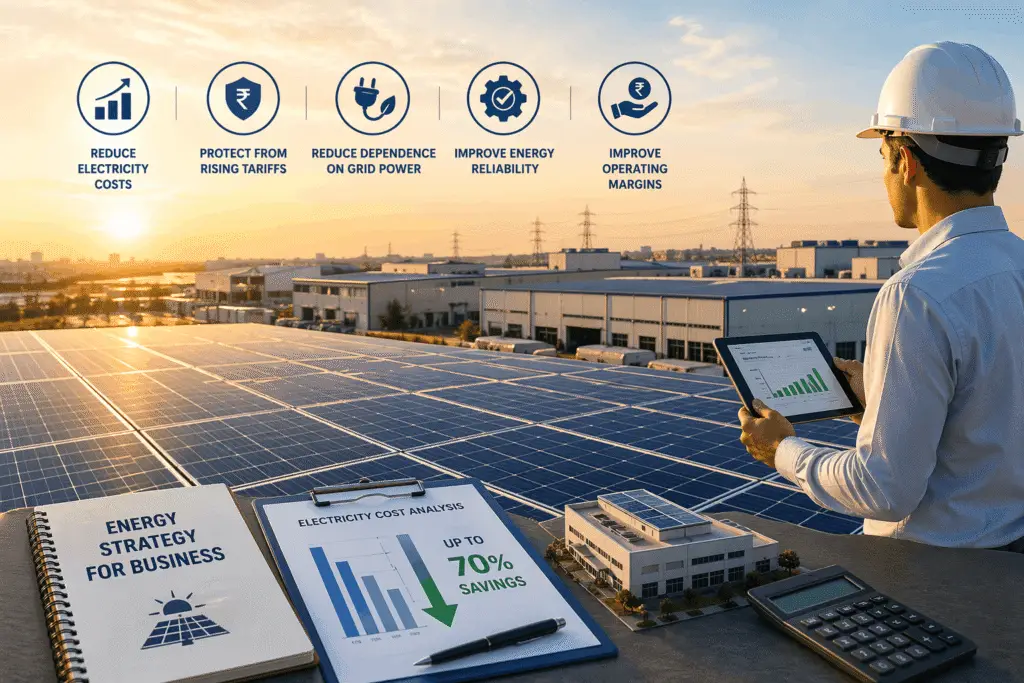
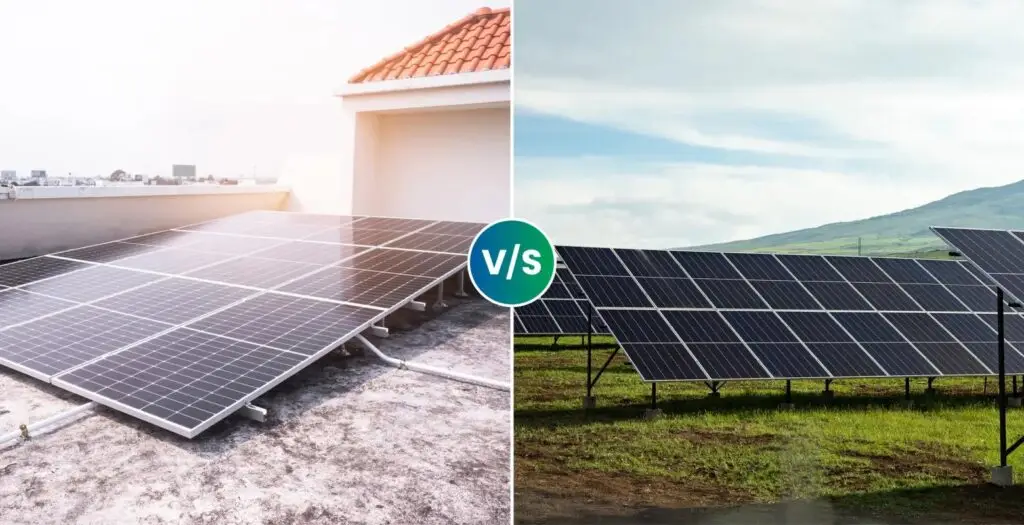
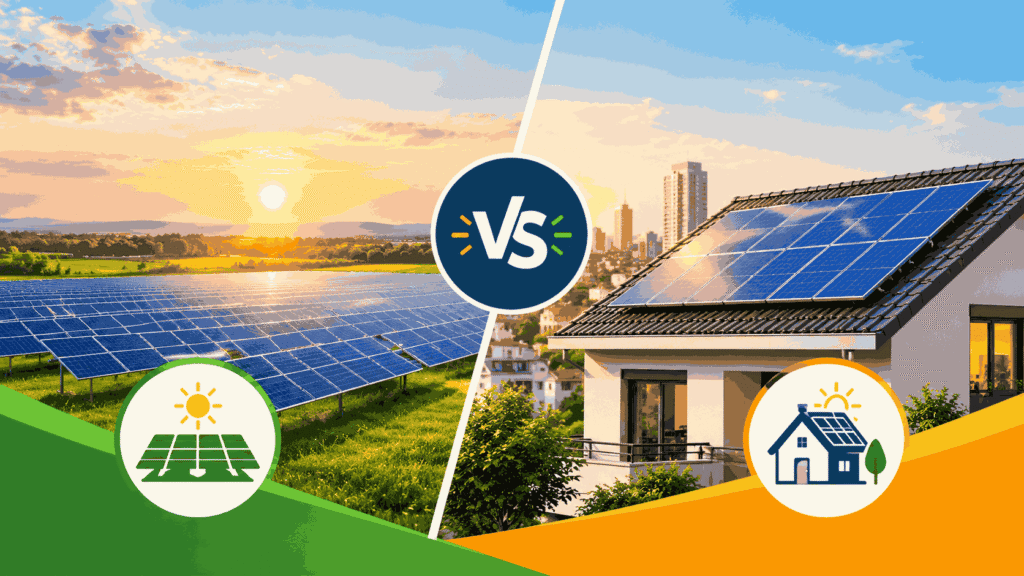
In rooftop solar, panels are mounted on the roof of your factory, warehouse, office, or other commercial facility. The energy produced is consumed on-site, decreasing the amount of power you need to purchase from the grid.
But with open access solar, a firm buys electricity from a solar power station situated somewhere else. The power is scheduled and delivered through the electricity grid, subject to applicable regulations, charges and settlement arrangements.
Open Access Solar vs Rooftop Solar
Comparison Factor | Rooftop Solar | Open Access Solar |
Generation location | At your business premises | At an off-grid solar plant |
Space requirement | Suitable roof or on-site area | No solar installation space required at the consumer’s premises |
Investment | On-site capital investment or a suitable third-party rooftop arrangement | Developer PPA, captive investment or group captive participation |
Project scale | Limited by usable site area and electrical constraints | Can support larger procurement requirements, subject to feasibility |
Electricity delivery | Direct on-site use, with grid interaction as applicable | Through the electricity network under approved arrangements |
Additional charges | Grid charges may apply to imports and exports, depending on the arrangement | Transmission, wheeling, losses, surcharges, banking and other applicable charges can affect landed cost |
Maintenance | On-site system maintenance and monitoring | Primarily managed at the generating plant by its owner or operator, as contracted |
Dependence on grid | Usually remains connected for supplementary power | Grid access and the relevant delivery arrangements are central to the model |
Best suited for | Businesses with usable roof space and compatible daytime demand | Businesses seeking larger-scale renewable procurement or lacking sufficient on-site space |
How Open Access Solar Works in India for C&I Businesses
Open access solar installation is where qualified consumers in industries and businesses get renewable energy from an external solar power plant. The ownership of the power generation plant could be individual developers, joint ownership among participating customers or captive consumer-specific.
As per the 2022 Green Energy Open Access Rules issued by the Government of India, the central eligibility threshold for green open access deals has been decreased to 100 kW without any minimum load restriction for captive users. But project viability and approvals should be based on state-wise rules and their modifications.
The Main Open Access Solar Procurement Models
There are three common ways businesses can procure solar power through open access.
1. Third-party open access solar
Such an arrangement could be perfect for companies seeking renewable energy without necessarily being involved in constructing the solar power station. The agreement must provide details on the capacity contracted, tariffs to be charged, period of contract, energy supply, payment terms and penalties.
2. Group captive solar
Under the captive group scheme, several consumers construct the generating plant and utilize electricity from it under the captive power scheme. This gives companies the chance to have a stake in the solar generation without constructing their own big projects.
3. Captive solar power
Captive solar power provides greater control over generation and procurement, but it requires capital investment, project management, and ongoing regulatory compliance.
Under the captive group scheme, several consumers construct the generating plant and utilize electricity from it under the captive power scheme. This gives companies the chance to have a stake in the solar generation without constructing their own big projects.
How Rooftop Solar Works for Commercial Buildings
Rooftop solar installation for commercial purposes involves installing PV panels on the roof to produce electricity. It usually consists of solar panels, inverters, mounting structures, protection devices, and monitoring systems.
Where Rooftop Solar Makes Most Sense
✔ C&I businesses with larger unused rooftops
✔ Regions with high solar irradiance with maximum energy generation potential
✔ Properties with unreliable grid power
✔ Businesses seeking long-term energy independence
What businesses should evaluate before installation
The professional feasibility study for installation of the solar system should take into account the power profile of the building, size of the roof that can be used for solar panels, adequacy of the structure for mounting the equipment, and current electricity connection of the building.
As far as C&I installations go, the objective is not to go for the biggest system that can fit. The idea is rather to go for the system which will give financially sound generation.
Group Captive vs Open Access Solar
This is where we want to fix any confusion between group captive and open access solar before moving forward.
Group Captive Solar refers to a situation whereby several commercial and industrial enterprises work together to build a solar power station outside their premises via a Special Purpose Vehicle (SPV).
Whereas Open Access Solar, which in this case is Third Party Open Access, purely involves the purchase of electricity whereby the plant owner sells power directly to the consumer.
When group captive may be worth evaluating
A group captive may be considered for a company that has significant and relatively stable demand for electricity, an extended time frame for investment, and capability of becoming part of the ownership structure.
When third-party open access may fit
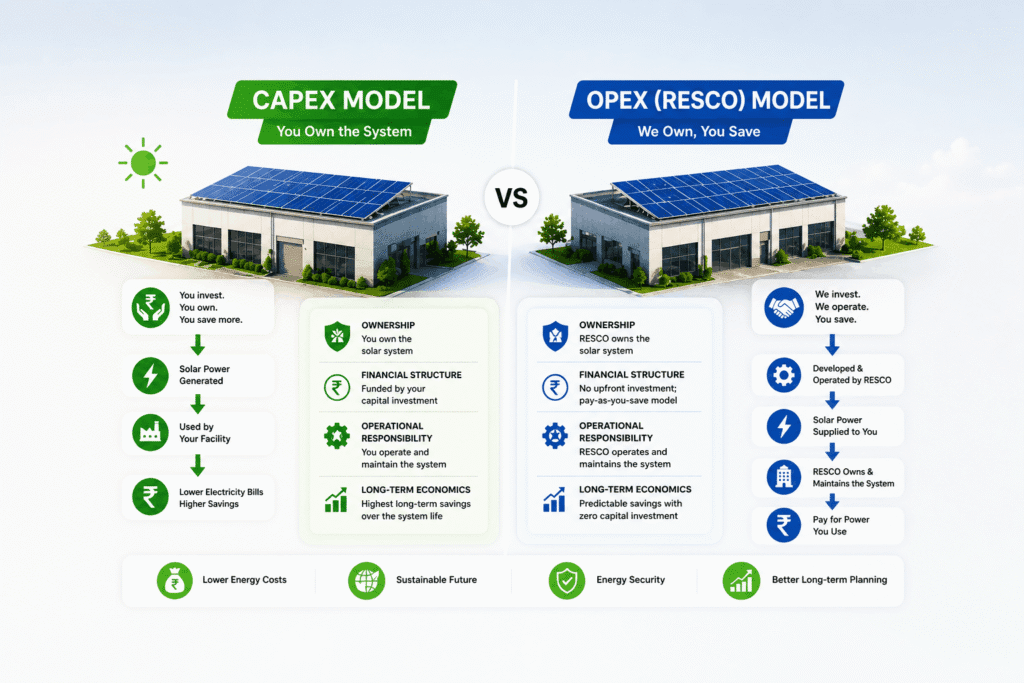
Third Party PPA is the best fit for businesses that seek green energy but cannot assume direct ownership of the power production facility. This contract model involves developers overseeing the process of project construction and running of the project and consumers paying for their electricity under the contract.
Wondering which solar module does your business need? Calculate solar ROI and find the best solar investment for your business.
Open Access Solar Cost and Savings vs Rooftop Solar
A low quoted solar tariff can look attractive on paper. But the rate printed in a proposal is not necessarily the amount your business ultimately saves on its electricity bill.
Both models can reduce electricity expenses, but their costs differ.
Factors | Open Access Solar | Rooftop Solar |
Approx. cost | ₹30–50/W (₹30,000–50,000/kW) installed | Often ₹3–5/unit as an indicative PPA tariff; landed cost varies |
Investment | Upfront installation or financing | PPA-based procurement or captive investment |
Savings | Reduces grid purchases through on-site generation | Savings depend on landed tariff versus grid electricity cost |
Which offers better savings?
Solar panels work well for companies with suitable roof space and daytime energy usage, whereas open access works well for companies requiring renewable energy from offsite locations. The exact cost savings will vary based on state regulations and usage patterns.
C&I Solar Open Access Eligibility India: What Businesses Need to Check
C&I consumers in India generally qualify for Green Energy Open Access if they have a contracted load or demand of 100 kW or higher, though specific thresholds depend on state-level electricity regulations.
Here’s a practical checklist that helps you understand whether you are eligible for open access solar in India.
A Practical Checklist
- Electricity consumption data
- Connection and tariff details
- Open access feasibility
- Commercial assumptions
- Future energy needs
With these details in hand, you can request comparable proposals rather than comparing one vendor’s installation quote with another vendor’s energy tariff.
Rooftop Solar vs Open Access Which Is Better for C&I?
The best option will depend on the needs of your business in terms of energy consumption, available space, and cost of electricity. If you have a roof that can accommodate solar panels and you consume large amounts of electricity during the day, then rooftop solar should definitely be considered.
C&I companies can benefit from the combination of the two models to ensure their ability to generate electricity and buy more renewable energy.
Looking to make the right solar investment for your business? SolarEssentials helps commercial and industrial businesses explore solar solutions aligned with their energy requirements and long-term goals.
Explore solar solutions with SolarEssentials and take a smarter approach to energy cost management.
Frequently Asked Questions (FAQs)
What is the main difference between open access solar and rooftop solar?
Solar energy on roofs produces electricity right on your business premises, whereas open access solar allows you to buy electricity from a solar power station somewhere off-site through the grid.
Which is more cost-effective for industries: open access solar or rooftop solar?
It all boils down to electricity usage, roof availability, utility rates, and additional charges. While rooftop solar can work for buildings that have high daytime energy usage, open access could work for firms that require more power.
What load size is suitable for open access solar in India?
As per the Green Energy Open Access Guidelines of the center, the general rule of eligibility in terms of contracted capacity or sanctioned load is that of 100 kW. There is no minimum load constraint on captive consumers.
Can MSMEs and small factories use open access solar, or is it only for large industries?
Yes, eligible MSMEs and small-scale industries may try out green open access if they satisfy the conditions set by the regulatory framework. The overall framework reduced the minimum threshold to 100 kW.
Does open access solar require equity investment like group captive solar?
No. Open Access involves third parties enabling businesses to buy energy using a PPA without having to own the solar farm. Group Captive involves an element of ownership and compliance with captive power laws.
What charges apply in open access solar (wheeling, CSS, additional surcharge)?
Based on the state and structure of the project, the fees may be inclusive of transmission and wheeling fees, electrical losses, cross subsidy surcharge (CSS), additional surcharge if any, bank fees, among others.
Is rooftop solar better for businesses with limited roof space?
Typically, space limitations of roofs limit how much solar power a company can install. Open access provides an option for generating green electricity without having to install solar panels.
How long are the power purchase agreements (PPA) in open access vs rooftop solar?
Solar power purchase agreements with open access generally range between 10 and 25 years. Rooftop solar can either be bought outright or through a third-party solar PPA that differs according to the terms of the agreement.
Can a company combine rooftop solar and open access solar for the same facility?
Yes. It is possible for a business to assess its potential for using rooftop solar energy both for self-consumption and for accessing extra renewable energy.
Which model helps more with ESG and net-zero goals: open access or rooftop solar?
Both these sources have the potential to help ESG and decarbonization objectives by reducing dependency on grid electricity from traditional sources. Which source is superior depends upon demand for renewable energy, the need for accounting of emissions, capacity, and energy usage records.