Solar technology is evolving more rapidly than we have ever imagined.
Among them, Monocrystalline TOPCon N-Type Bifacial is gaining attention faster. By combining N-type silicon, TOPCon cell architecture, and bifacial energy generation, these modules are designed to improve renewable energy usage efficiently.
But does this efficiency automatically mean better returns in the future? The real advantage depends on factors like temperature performance, bifacial gain, installation conditions, degradation, and overall system design.
Ahead, we have shared how N-Type TOPCon bifacial technology works, where it performs best, and why it could play a major role in India’s next generation of solar projects.
What Is Monocrystalline TOPCon N-Type Bifacial Solar?
Let’s break down the terminology because there are three different ideas working together in this solar module.
Monocrystalline: Monocrystalline refers to the form of the silicon wafer used to make the solar cells. The use of monocrystalline silicon has been extensive due to its uniform crystalline structure, which facilitates high efficiency.
N-type: N-Type is used to characterize the electrical doping of the silicon wafer. N-type wafers use phosphorus as the main dopant, making them less vulnerable to boron-oxygen effects.
TOPCon: The TOPCon or Tunnel Oxide Passivated Contact uses a very thin oxide film and a passivating contact structure in order to minimize losses from recombination. This is how it increases the conversion of the energy collected by the cell into electrical energy.
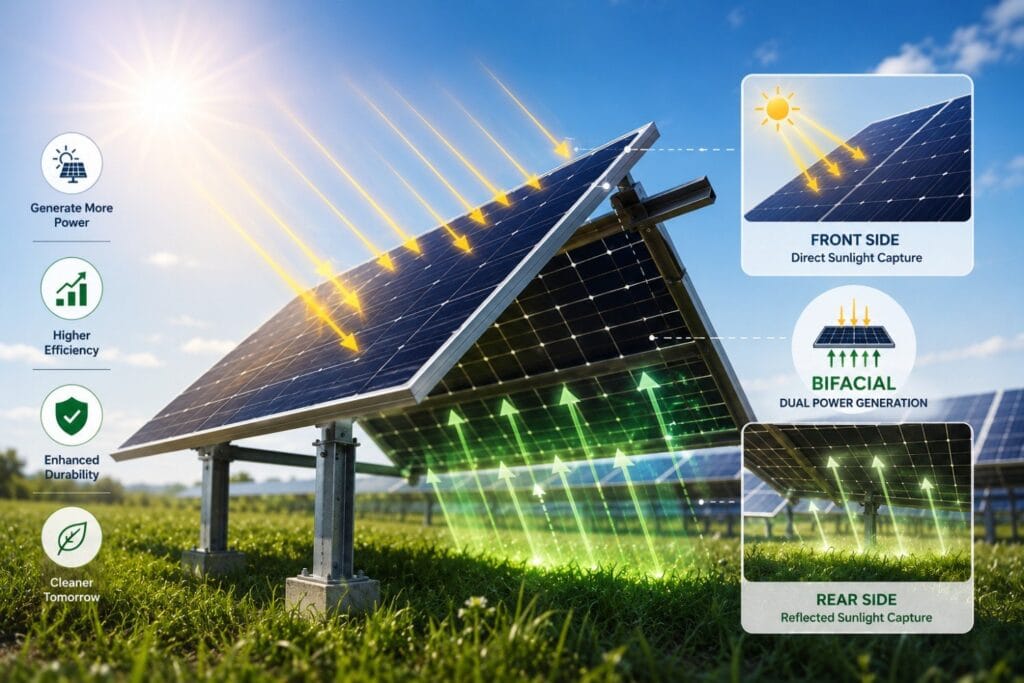
Lastly, bifacial means the module can generate electricity from light reaching both its front and rear sides.
Monocrystalline TOPCon N-Type bifacial means a high-efficiency solar cell architecture combined with TOPCon technology and a two-sided energy-generation capability.
Why Are N-Type TOPCon Solar Panels Getting So Much Attention?
N-Type TOPCon solar panels are gaining massive attention because they offer over 22-25% higher energy efficiency at lower degradation rates. Here’s why it is gaining attention fast:
1. Efficiency & Power
- Adds an ultra-thin oxide layer to reduce electron recombination.
- Can reach up to 25% or more in mass production.
- Generates power from both sides with high efficiency.
2. Durability & Performance
- Suffers minimal power loss in the first year & over time.
- Performs better in high-temperature weather with a lower temperature coefficient.
- Can capture energy even on cloudy days or in the early morning.
3. Cost & Manufacturing
- Industries can switch from P-type PERC lines to N-type with low retooling costs.
- Delivers more power per square meter, lowering overall project costs.
How Do the Backs of Bifacial Solar Modules Work?
Unlike traditional panels that use an opaque backsheet, bifacial solar modules generate electricity from both sides.
- Double-Sided Cells: Use specialized photovoltaic cells with grid-like or open metal contact fingers on the back instead of a solar aluminium sheet.
- Active P-N Junctions: Photons penetrating through the rear transparent layer strike the silicon wafer from below, freeing electrons just like the front side.
- Capture Reflected Sunlight: The rear side of a bifacial solar module captures sunlight reflected from the ground, rooftop, sand, concrete, or other surrounding surfaces.
- Mounting Clearance: Panels need to be placed at an even greater tilt or on elevated ground racks for adequate sunlight to hit the rear side. The flush-mounted roofs in residences severely hamper rear-side generation.
Where Do Monocrystalline Bifacial Solar Panels Work Best?
Commercial & Industrial Rooftops
For commercial and industrial solar with considerable electricity usage during daytime hours, high-efficiency panels will be essential in optimizing electricity production when there is limited roof area available.
Nonetheless, the performance of roof-mounted bifacial panels requires careful analysis due to the impact that roof color, panel height, and design may have on rear-side irradiation.
Utility-Scale Solar Projects
It is especially interesting to apply this technology in large-scale projects of the ground type since it provides great possibilities to manipulate the mounting height, row distance, and the conditions of the surface of the soil.
In these projects, even a small gain in energy yield may become very profitable due to their scale.
High-Temperature Regions
The properties of TOPCon with respect to temperatures would make it suitable for use in areas where the temperatures are very high. The benefit becomes even more significant when the performance is analyzed based on real-time conditions.
Projects Focused on Long-Term LCOE
If the module cost today forms the basis for the procurement decision, then the technology which has higher upfront costs may not seem very appealing.
But once one starts including factors such as degradation, energy production, land use efficiency, balance of systems costs, and lifetime generation, things become very exciting. Modelling comparisons have shown that N-type TOPCon can lower LCOE under certain project assumptions.
Are N-Type Solar Panels in India Really Changing the Future?
N-Type solar panels are becoming one of the defining mainstream technologies of the current solar transition.
But the bigger shift can be seen through how India is evaluating solar technology. Today, smart businesses as well as homeowners are looking beyond the lowest upfront cost and paying more attention to lifetime green energy generation.
But Monocrystalline TOPCon N-Type Bifacial is not automatically the best choice for every project. Roof design, mounting height, surface reflectivity, shading, and installation quality all influence the final output.
Final Thoughts
Monocrystalline TOPCon N-Type Bifacial panels may prove to be very efficient in this case. However, it should be noted that it is possible to fully realize the potential of this technology only if you choose the proper project design.
When choosing commercial/industrial/utility scale solar panels in India, think about how much electricity your project will produce during its lifetime, not just its peak power output. The proper use of TOPCon bifacial panels allows you to get the most of your budget.
If you are planning for an N-Type Bifacial solar panel installation, connect with SolarEssentials and get a complete solar assessment before final installation.
Frequently Asked Questions (FAQs)
What are Monocrystalline TOPCon N-Type Bifacial Solar Modules?
They are highly efficient solar panels made using monocrystalline N-type cells, top contact (TOPCon) cells, and bifacial cells. They produce power from both the front and back sides, with the back side receiving reflected or diffused sunlight.
How do N-Type TOPCon solar panels work?
N-TOPCon modules feature a passivated contact design that minimizes electrical losses by reducing recombination within the solar cell. More of the sun’s energy can then be transformed into electricity, and the n-type cell design is resistant to specific types of degradation.
What are the benefits of bifacial solar modules?
One important advantage is the opportunity to produce extra power from rear-side illumination without increasing the size of the PV module itself. The degree of bifacial advantage is based on several variables. This includes reflectivity and module height. Also row spacing and shading conditions.
Are TOPCon solar panels more efficient than PERC panels?
Normally, N-type TOPCon modules have more efficiency potential compared to PERC modules. But the efficiency is not consistent between different brands. Therefore, one has to refer to the datasheet in order to understand the efficiency potential.
How much power can a bifacial TOPCon solar module generate?
There is no universal output figure for all bifacial TOPCon panels. The front-side wattage rating for each module will differ from one another. The overall energy production will depend on the rear irradiance at the site of installation.
What is the difference between N-Type and P-Type solar panels?
The distinguishing factor lies in the type of silicon wafer used in the cell. N-type cells are more resistant to some degradation caused by sunlight that affects P-type cells and, therefore, are preferred for high-performance, durable solar cells.
Are bifacial solar panels suitable for rooftop installations?
Yes, but their efficiency depends a lot on the roof design. The elevated mounting system with good rear-side exposure and a relatively reflective roof will make the panels more efficient, but an elevated panel installed on a non-reflective roof is less efficient.
How much do N-Type TOPCon bifacial solar modules cost in India?
Price depends on wattage, supplier, whether it’s DCR or not, efficiency, certifications, quantity ordered, and prevailing market conditions. Therefore, it would be advisable to ask for quotations for the specific module being considered rather than use a standard price per watt. Recent market prices reveal considerable differences in prices between DCR and non-DCR TOPCon modules.
What factors affect the performance of bifacial solar modules?
The key variables include rear-side irradiation, ground or roof albedo, module height, tilt, distance between rows, shading, mounting system, and bifaciality of modules. These can significantly affect the performance of a project in terms of bifacial yield gain.
Are Monocrystalline TOPCon N-Type panels a good investment for commercial solar projects?
They can be a good option, especially when high energy yield, restricted space availability and good performance are taken into consideration. The return on investment must be calculated with the total project economics in mind, which consist of panel cost, energy yield, degradation, bifacial benefit, BOS cost and levelized cost of electricity.