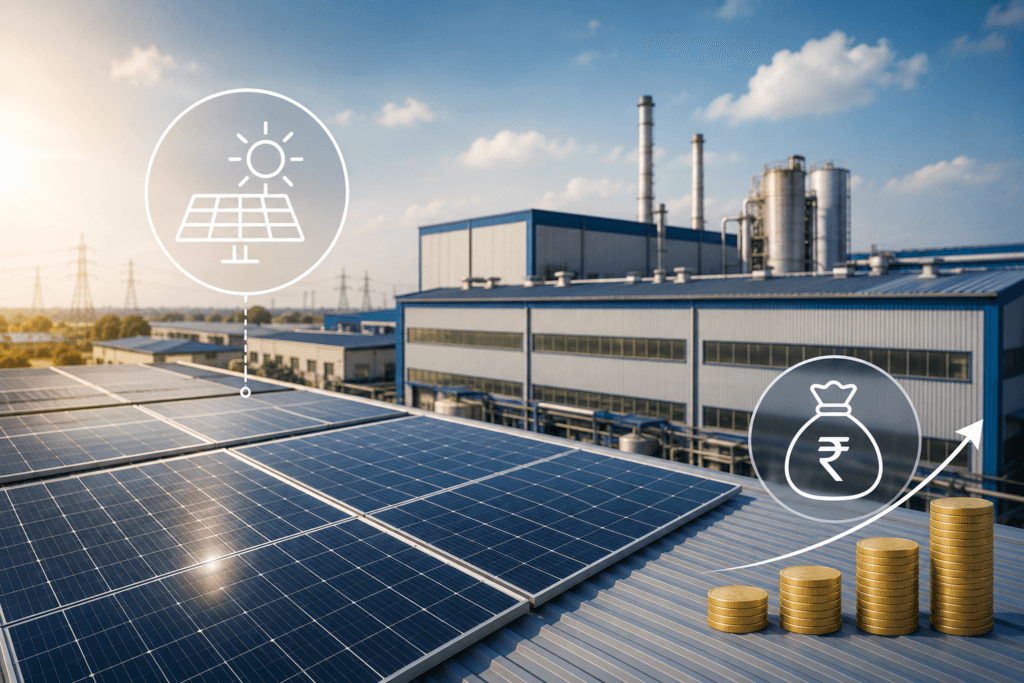
The growing electricity demand and the government’s increasing focus on renewable energy are encouraging commercial and industrial facilities to invest in solar. Among all options, the 1 MW project is the most popular one businesses are investing in.
However, for C&I businesses, the real investment decision is not simply about buying solar panels. It is about replacing expensive grid electricity with a long-term energy asset that can potentially deliver savings for two decades or more.
So, if you are also curious about the 1 MW solar plant cost and ROI in 2026, let’s understand it in detail.
What Is the 1 MW Solar Plant Cost in India in 2026?
For larger C&I projects in India, a 1 MW solar plant is not mandatory but a highly practical and profitable choice in the long run.
The approximate cost of a 1 MW solar plant in India ranges from ₹3.4 crore to ₹4.5 crore. However, it also depends on whether it is rooftop or ground-mounted and what is included in the EPC scope.
Current industry benchmark places that:
➜ 1 MW rooftop projects= Around ₹3.4-4.2 crore
➜ 1 MW ground-mounted projects= ₹3.6-5 crore
A useful way to look at the budget is on a ₹/Wp basis.
Indicative 1 MW Solar Project Cost
Cost Head | Typical Share / Consideration |
Solar PV modules | ~50–55% |
Inverters | ~10–15% |
Mounting structures | ~10–15% |
Cables, BOS & electrical equipment | ~5–10% |
Civil work & installation | ~5–10% |
Monitoring, SCADA & grid integration | ~2–5% |
Land, evacuation & site-specific costs | Project dependent |
The exact percentage varies by technology and EPC scope. Also, module pricing, inverter selection, structure design, site conditions, and grid connectivity can move the final project price considerably.
Ground Mount vs Rooftop: What Causes More Money?
Ground Mount Solar Plant Cost
A ground-mounted system gives the developer greater control over orientation, layout, and future expansion. A 1 MW ground-mounted plant generally needs around 4 to 5 acres. But the actual requirement depends on module wattage, layout, setbacks, and site conditions.
For companies that are thinking about the ground-mounted solar plant cost, please keep in mind that there are other costs involved besides the cost of the panels and structure. These include land development, fencing, internal road construction, drainage, soil conditions, distance and transmission capacity.
Rooftop Solar Plant Cost
But a rooftop solar plant can make financial sense when a factory or warehouse already has sufficient, structurally suitable roof space. It also avoids the land purchase or lease component associated with a ground-mounted project.
What Is the Commercial Solar Plant Payback Period
The commercial solar plant payback period typically ranges from 3 to 5 years, although it may vary up to 6 or 7 years depending on the location and electricity rates, among other things.
How to Calculate the Solar Investment Payback
A simple first-pass calculation is
Annual Solar Savings = Annual Solar Generation × Effective Electricity Cost
Then calculate:
Simple Payback = Total Project Cost ÷ Annual Net Savings
For instance, consider solar panel installation for a shopping mall:
₹4 crore project ÷ ₹1.25 crore annual net savings = approximately 3.2 years
What Is the 1 MW Solar Project IRR?
When you are evaluating solar as an investment, IRR becomes more useful than simple payback.
Commercial & industrial solar installation projects usually recover their initial capital within four years. But that does not tell you that the investment is worth it over its entire operating life.
IRR considers the timing of cash flows and therefore gives investors a better way to compare solar against other capital investments.
For a C&I project, the 1 MW solar project IRR depends on factors such as:
- Initial EPC CAPEX
- Annual generation
- Electricity tariff being displaced
- Solar degradation
- O&M expenses
- Tariff escalation
- Financing cost
- Tax treatment and depreciation
- Project life
- Curtailment or downtime
- Open-access charges, where applicable
Captive Solar Plant Cost India: Why the Business Model Matters
For C&I consumers, the biggest mistake is giving more focus to captive solar plant costs in India without deciding how the generated electricity will reach the factory.
There are several models, including:
Behind-the-Meter Solar
The easiest configuration is producing power at the site where it is being used.
It does not make any sense to worry about how to get the power away from the plant, as is the case with off-site power plants. Economics are especially attractive if there is high power usage during daytime at the plant.
Captive or Group Captive Solar
The company can also consider investing in a captive or a group captive project where power generation takes place at a distance from where consumption occurs.
Other aspects like transmission, wheeling, banking, open access issues, and associated costs need to be factored in. In case of a group captive arrangement, aspects of ownership and consumption will also figure in the financial modeling.
Open Access / Third-Party PPA
A PPA or OPEX/RESCO option could turn the economic model from CAPEX spending to power buying for those organizations that cannot afford to spend a few crore rupees at once.
This would be an appealing proposition for enterprises with less CAPEX funding, but its benefits should be compared with the PPA rate and tenure.
Ready for Industrial Solar Power Plant Investment?
A reasonable 2026 planning benchmark puts a 1 MW C&I solar project broadly in the ₹3.2 to ₹5 crore range, depending on rooftop or ground-mounted installation.
A well-designed plant can generate roughly 14 to 17 lakh units annually. However, the actual ROI depends on the value of those units and not simply on the number printed on the solar plant’s nameplate.
So, if you want to evaluate an industrial solar power plant investment & trying to understand the installation cost with probable ROI, our team is here to help. Connect with SolarEssentials and get a detailed solar assessment today!
Frequently Asked Questions (FAQs)
What is the total cost of a 1 MW solar plant in India in 2026?
A solar power plant with a capacity of 1 MW normally costs about ₹3.5 to 5 crores in the year 2026 on a turnkey basis. The actual cost will be dependent upon various factors.
How much land is required for a 1 MW ground-mount solar plant?
One megawatt ground-mounted solar installation usually needs between four and five acres of land. The precise figure is determined by module efficiency, layout of the system, row spacing, and terrain.
What is the expected annual energy generation from a 1 MW solar plant?
A one-megawatt solar power plant can produce 14 to 17 Lakh units per annum in India. The exact power output depends on site location, sunlight received, efficiency of the power plant, etc.
What is the typical payback period for a 1 MW captive solar plant?
An effectively designed solar power system of 1 MW capacity may take around 3-5 years for simple payback, depending on the favorable electricity tariff rates for C&I applications. The exact period would depend largely on the CAPEX of the project, generation, self-consumption, and cost of electricity displaced.
What IRR can investors expect from a 1 MW industrial solar project?
An industrial solar plant at 1MW scale has the potential to earn high-teens IRRs, with some captive projects having IRRs of about 18-22%. Nonetheless, the calculation of IRRs must always be done according to the specifics of the project, including tariff, generation, finance, degradation, and operation costs.
What are the main cost components of a 1 MW solar power plant?
The main cost items comprise solar panels, inverters, mounting systems, DC/AC cables, transformers, electrical systems, civil works, installation, monitoring and evacuation systems. Additional costs for land, permitting and other site-specific facilities might be incurred as well.
Is accelerated depreciation available for 1 MW captive solar plants?
Yes, companies can apply for accelerated depreciation for their solar power equipment depending on the Income Tax Rules existing at that time. However, it is best to consult a tax expert since it depends on the type of equipment and the organization’s structure whether they can qualify or not.
Can a 1 MW solar plant be used under the open access model?
Of course, a 1MW project can indeed be designed in the open access regime, provided that the relevant central and state laws are followed. The economic feasibility of such a project will largely depend upon the wheeling, transmission, banking, and other relevant charges.
What approvals and clearances are needed for a 1 MW solar project?
Based on the project type and state, approvals can consist of land-use approval, DISCOM/grid connectivity approval, electrical inspection approval, metering, open access, etc. However, the specific list of approvals required depends upon the project type captive, rooftop, or open access.
Should industries choose CAPEX, OPEX, or PPA for a 1 MW solar plant?
Capital Expenditure is ideal for organizations having capital for generating maximum savings and owning assets. Operating Expenditure and Power Purchase Agreement are ideal for those firms that do not wish to make any initial investments, whereas group captive could act as a middle path between owning assets and minimizing capital outlays.