Energy expenses are the fixed costs that never actually stay fixed.
Every business owner knows the feeling when electricity bills arrive and margins get tighter. But you can actually control them… through commercial solar power installation!
Across India, businesses are no longer considering solar as a sustainability initiative alone. They are treating it as a smart financial strategy.
How?
Let’s find out ahead!
Why Businesses Are Moving Toward Commercial Solar Faster in 2026
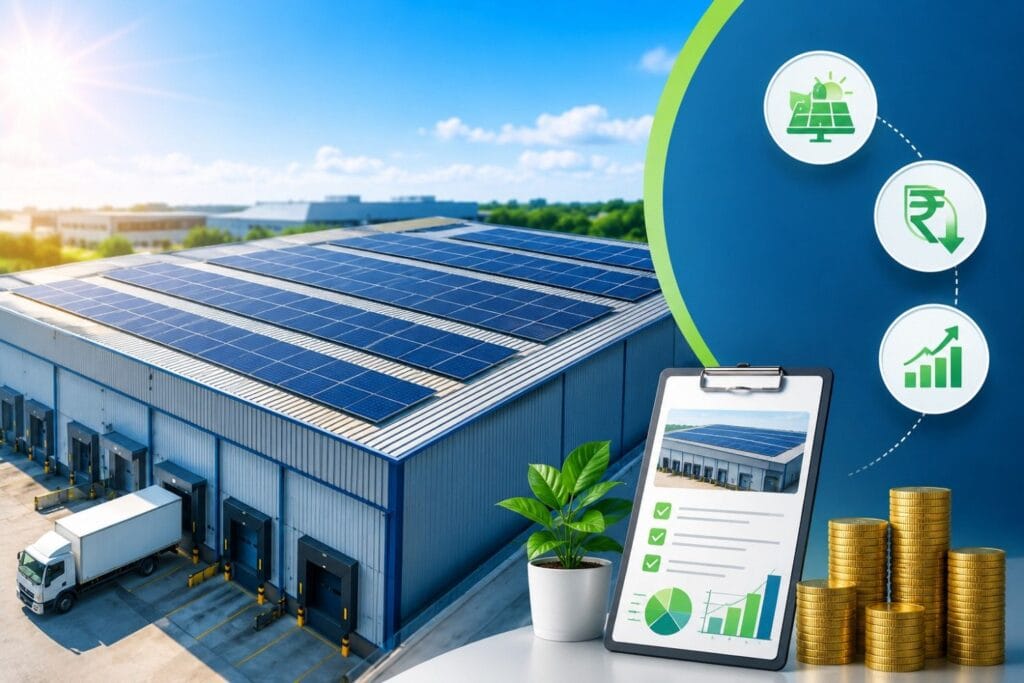
The amount of energy consumed commercially is far greater than residential consumption. Commercial sectors like factories, warehouses, hotels, hospitals, offices, retail stores, and educational centers use vast amounts of energy monthly.
… and the only challenge is: the continuous rise of energy prices while companies must remain competitive.
That’s why commercial solar solutions create a measurable advantage.
Instead of continuously paying utility bills with no return, businesses with commercial solar power generate a huge portion (sometimes most) of their own electricity bills.
The results?
✔ Protection against energy cost fluctuation and rising tariffs
✔ Increased property value attracts more tenants
✔ Establish your company as an environmental leader
✔ Using a battery alongside to store solar power and protect against power outrage
What Are the Benefits of Commercial Solar Power Installation?
Many decision-makers in India still think that solar is primarily about environmental responsibility. But that’s outdated thinking.
Let’s check out the real benefits of commercial solar power installation here:
Lower Monthly Operating Costs
Solar energy reduces dependence on electricity from the grid, which instantly translates into lower monthly costs.
Businesses working around the clock, like factories, commercial buildings, and logistics centers, save energy costs in the long run. Also, partial solar power adoption can create noticeable cost reduction.
Strong Long-Term ROI
Unlike marketing campaigns and software subscription costs, Rooftop Solar for commercial buildings keeps giving value long after its installation.
Additionally, the majority of commercial solar systems are built to be highly durable with minimal maintenance needs. That means businesses benefit from years of electricity savings after recovering the initial investment.
Protection Against Rising Energy Costs
It’s hard to predict energy costs.
However, using renewable energy sources to create energy shields you from any increases in tariffs down the road. Companies that install solar energy ahead of their competitors can enjoy greater flexibility when it comes to prices.
Which Industries Are Seeing the Highest Impact
Solar works across multiple business categories, and here are some sectors that see faster returns:
➤ Manufacturing Facilities
As manufacturing facilities require high daytime electricity consumption, commercial solar power use cases are strongest among them.
➤ Office Buildings
Generally, office operations also align with solar generation hours. That’s why the corporate sector is installing rooftop solar for commercial buildings to gain power independence.
➤ Agriculture & Farming
Advanced farming and agriculture require high-energy-intensive operations. This includes solar water pumping and irrigation systems. Solar power installation supports remote operations, reducing dependence on inconsistent grid connections.
➤ Hospitality & Healthcare
Hospitality and healthcare also require massive 24/7 energy for constant HVAC usage, guest-room electronics, and machinery usage. Commercial solar boosts eco-credentials while saving a lot of electricity costs.
Things Businesses Must Elevate Before Solar Power Installation
But remember that not every solar setup delivers the same results. The quality of planning often determines long-term performance.
Here are the things that you need to evaluate before making a final installation decision:
- Energy consumption patterns
- Rooftop condition and usable area
- System sizing
- Maintenance support
- Payback period expectations
- Scalability for future growth
Only a properly designed commercial solar power installation should align with your business goals, not just installation capacity.
Ready to Turn Your Rooftop Into a Revenue-Saving Asset?
Businesses that are gaining the most from solar are not waiting for perfect conditions or time. Even most industry leaders are making informed decisions early.
Connect with SolarEssentials and book your free solar savings assessments to get tailored commercial solar solutions based on your building and growth goals. Let’s consult your commercial solar power installation today!
FAQs
What is commercial solar power installation and how does it work?
Steps for commercial installation of solar power systems include installing the solar panels along with other required equipment in order to utilize solar energy and transform it into electric energy. Such systems help businesses lessen their reliance on electricity from the power grid.
Why is commercial solar power installation a smart investment for businesses?
Installing commercial solar power is a smart investment for businesses. It can convert unused rooftops into revenue generating assets by generating solar power electricity and cutting down bills by up to fifty to eighty percent.
How much does commercial solar power installation cost in India?
Commercial solar power installations in India typically cost between thirty and sixty thousand rupees per kilowatt. It also depends solely on the system’s capability, panel quality, and size.
How much can businesses save on electricity bills with commercial solar power?
The exact saving amount depends on the size of the installation, local utility tariffs, and the daily energy usage as per your requirement. For most energy-intensive industries operating during the daytime, the amount of savings can range between fifty and ninety percent.
What is the average ROI and payback period for commercial solar installations?
The average return on investment and payback period for commercial solar installations are typically within three to six years. After the system is paid off, the remaining years of energy production are pure savings.
Which commercial properties are suitable for solar power installation?
Primarily, commercial properties with large, non-shadowed rooftops are suitable for solar power installations. The property type can be warehouses, manufacturing plants, office buildings, retail centers, hospitality & healthcare buildings, or educational institutions.
How much rooftop space is required for a commercial solar power system?
Around 80 to 120 square feet (7 to 11 square meters) of shadow-free rooftop is required for a commercial solar power system. However, it also depends on the system capability and panel efficiency.
Are there any tax benefits available for commercial solar power installation in India?
Absolutely. Both commercial and industrial solar systems are substantially supported by the availability of Input Tax Credit, Accelerated Depreciation, as well as other benefits at the state level. We highly recommend considering contacting an expert in the field before making a final investment.
How long does a commercial solar power installation take to complete?
The project installation timelines vary based on system size and site conditions. Most commercial solar projects are completed through stages including assessment, design, approvals, installation, testing, and commissioning. So, it can usually take around two to six weeks.
How do I choose the right commercial solar installation company for my business?
Choosing the right solar company requires identifying their experience, financial stability, and post-installation support. Trust firms like SolarEssentials, which has a strong commercial portfolio, transparent warranty terms, and high-quality equipment.