Is your home, farm or commercial facility built in a rural area? In this scenario, most of the nearest reliable power connection is several miles away.
The electricity supply is either unpredictable or unavailable during peak times. But relying on diesel generators is not a cost-effective solution.
That’s why off-grid solar power systems have been designed to operate independently!
The Ministry of New and Renewable Energy (MNRE), India, recognizes off-grid solar applications for locations where grid power is unreliable. As of August 2026, India has more than 6.6 GW of cumulative off-grid solar capacity.
But how do off-grid solar systems actually work? And how much should you expect to invest?
Let’s break it down!
What Are Off-Grid Solar Power Systems?
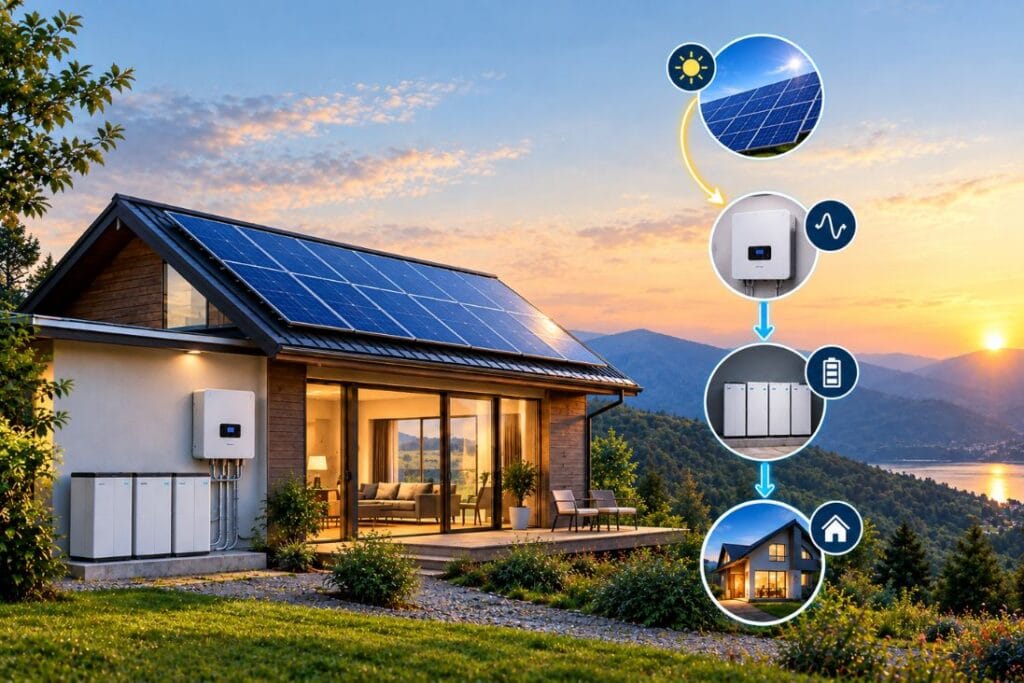
Off-grid solar power systems are standalone solar setups that can generate, store and supply electricity without relying on the utility grid.
It typically consists of:
✔ Solar panels
✔ Solar charge controller or MPPT system
✔ Battery bank
✔ Off-grid solar inverter
✔ Mounting structures
✔ Protection and electrical components
The key difference is the battery.
With a typical grid-connected solar system, electricity can be imported from or exported to the grid. As it does not have that safety net, it therefore needs sufficient battery storage and an appropriately sized inverter to keep essential loads running when sunlight is not available.
You may confuse it with how hybrid solar systems work. Follow the section below for better understanding.
What Is the Difference Between Off-Grid and On-Grid Solar?
Feature | Off-Grid Solar | On-Grid Solar |
Grid connection | Not required | Required |
Battery | Essential for standalone operation | Usually not required |
Night-time power | Battery supplies stored energy | Grid supplies power |
Grid outage | Can continue operating if properly designed | Standard systems shut down |
Excess solar | Stored or curtailed | Can potentially be exported |
Suitable for | Remote/unreliable-grid locations | Areas with reliable grid access |
Initial cost | Generally higher due to batteries | Generally lower |
How Does the Solar System for Areas Without Electricity Work?
The working principle of an off-grid solar power system is relatively simple.
Step 1: Solar Panels Generate Electricity
Solar panels convert sunlight into DC electricity during the day.
The amount generated depends on factors such as solar irradiation, panel capacity, orientation, shading, temperature and system efficiency.
Step 2: Charge Controller Manages the Energy
The solar charge controller regulates electricity going into the batteries.
Modern systems commonly use MPPT technology. This helps extract power efficiently from the solar array under varying operating conditions.
Step 3: Batteries Store Excess Energy
When solar panels generate more electricity than the current load needs, the available surplus can be directed into the battery bank.
That stored energy becomes particularly useful after sunset or during periods of low solar generation.
Step 4: Inverter Supplies Usable AC Power
Household appliances & modern heavy-duty machinery run on AC electricity, while solar panels and batteries produce or store DC electricity.
The off-grid solar inverter converts stored DC electricity into AC power that household and commercial appliances can use.
Step 5: Stored Energy Powers Appliances
At night or whenever solar generation is not sufficient, the system draws energy from the battery.
That’s what makes an off-grid system fundamentally different from a solar installation designed only around daytime generation.
What Are the Benefits of an Off-Grid Solar Power System
- For locations where grid availability is the main challenge, an off-grid solar system can be more valuable than simply calculating monthly bill savings.
- It can quietly generate energy during the day and use stored power when required.
- MNRE’s off-grid programmes have included applications specifically intended for areas where grid electricity isn’t available or is unreliable.
- Battery capacity can be designed according to the required backup duration and load profile.
What Components Are Needed in an Off-Grid Solar Power System?
A professionally designed standalone solar power system is more than a collection of panels and batteries.
Off-Grid Solar Panels
Good-quality solar panels are responsible for generating electricity from sunlight. For instance, N-TOPCon bifacial solar panels can generate solar energy from both sides.
The required capacity depends on your daily energy consumption and the amount of usable sunlight available at the installation location.
Solar Battery Backup System
The battery stores energy for later use.
Battery capacity is one of the most important design considerations because your backup duration depends heavily on how much usable energy can actually be stored.
Off-Grid Solar Inverter
The inverter converts DC electricity into AC electricity and manages power delivery to connected loads.
The inverter selection depends on the type and the requirements of appliances. Refrigerators, pumps, industrial machines and heavy-duty equipment have a significantly higher starting demand.
Solar Mounting & Protection Equipment
Monitoring structures, cabling, earthing, surge protection and other electrical protection components complete the installation.
These may not be the most visible parts of the system, but cutting corners here can affect safety, reliability and long-term performance.
What Is Off-Grid Solar System Cost in India?
An off-grid solar system in India costs anywhere from ₹50,000 for residential setups to over ₹10 lakhs for industrial systems.
However, the total installation cost may depend on the load, panel type & quality, inverter capacity, installation conditions, backup duration, and other important factors.
Homeowners can get subsidy benefits if they come under the PM Surya Ghar scheme, with subsidy amounts starting from ₹30,000 up to ₹75,000.
Ready to Install a Standalone Solar Power System?
If your property deals with unreliable energy during peak times, off-grid solar power systems may be a great sustainable option.
But the ROI only pays off well when the system is designed around your actual requirements rather than buying the biggest panel and battery package available.
What your project needs is a transparent solar assessment. Not the cheapest solution.
Talk to the solar expert and evaluate your load profile. SolarEssentials only designs systems around your actual energy requirements.
Frequently Asked Questions (FAQs)
What is an off-grid solar power system?
A Solar Energy Power System Operating Off The Grid is a self-sufficient system that does not depend on any external source of electrical supply and generates energy from the sun.
How does an off-grid solar system work?
The production of electricity using the solar panel occurs during the day. The system produces electricity for the connected devices while the excess energy is stored in the battery.
What are the main components of an off-grid solar system?
The key elements of a typical PV system include solar panels, an off-grid inverter, a battery system, a charge controller/MPPT system, mounting structures, and wiring. These may vary depending on the type of system being installed.
Does an off-grid solar system need batteries?
Yes, batteries play an integral part in a stand-alone system since there is no utility grid from which power is obtained once the system stops generating power using the sun. The stored power may be drawn on during such times.
Can an off-grid solar system work at night?
Yes. The solar panels do not produce electricity during nighttime. This means that the system uses the power stored in its batteries to run. The amount of reserve power is dictated by the battery capacity and load.
What happens to an off-grid solar system during cloudy or rainy days?
Solar panels are capable of producing electricity due to the availability of light, but the electricity produced will definitely be less due to cloudy weather or rainfall, etc. The battery helps in supplying extra power if the production from the solar panels is inadequate.
Can an off-grid solar system export electricity to the grid?
An off-grid system will not be able to transfer power to the utility grid since it is not hooked up to it. You can opt for a grid-tied or hybrid system in the case where you wish to utilize all three sources of power.
How do I calculate the right off-grid solar system size for my home?
Begin by calculating your energy usage needs on a daily basis, the peak power and the backup time you will require. From there, determine the size of your solar panels, inverter, and battery bank based on that information.
Is an off-grid solar system suitable for farms, remote homes, and small businesses?
Yes. Off-grid solar energy is useful in situations where there is no access to grid electricity. MNRE lists such applications for off-grid solar power, which include solar pumping and solar home lighting systems.
What is the difference between off-grid, on-grid, and hybrid solar systems?
Off-grid systems are independent systems and they use batteries. On-grid systems are systems that are connected to the grid and they do not need batteries under normal conditions. Hybrid systems are systems that utilize solar and batteries and they can be connected to the grid.