India has crossed over 40 lakh residential rooftop solar installations, largely driven by the national PM Surya Ghar: Muft Bijli Yojana.
The Ministry of New and Renewable Energy (MNRE) has already proposed a redesigned rooftop solar scheme, PM Surya Ghar 2.0, for homeowners in India. This program is still in the proposal phase.
But how does this differ from the current scheme?
This may reward actual power generation rather than rewarding the installed capacity alone. Also, support for battery storage and extended benefits for households are part of the media discussion.
Let’s understand what could really be coming with this new scheme, the hidden opportunities for homeowners, and what initiatives you must take right now to get the most benefits.
Why the Existing PM Surya Ghar Scheme Was Just the Beginning
PM Surya Ghar: Muft Bijli Yojana was a successful scheme by the Government of India. This has encouraged millions of households to adopt rooftop solar by offering attractive subsidies.
However, the official implementation deadline of this scheme is March, 2027. So, we can expect the upgraded scheme, Surja Ghar Yojana 2.0, to be officially announced before that.
Because the Indian solar market has evolved rapidly. So, households need solar power for high-time use and housing societies need shared rooftop solar.
These changing expectations are exactly why the next phase could look very different.
The Biggest Changes We May See in PM Surya Ghar 2.0
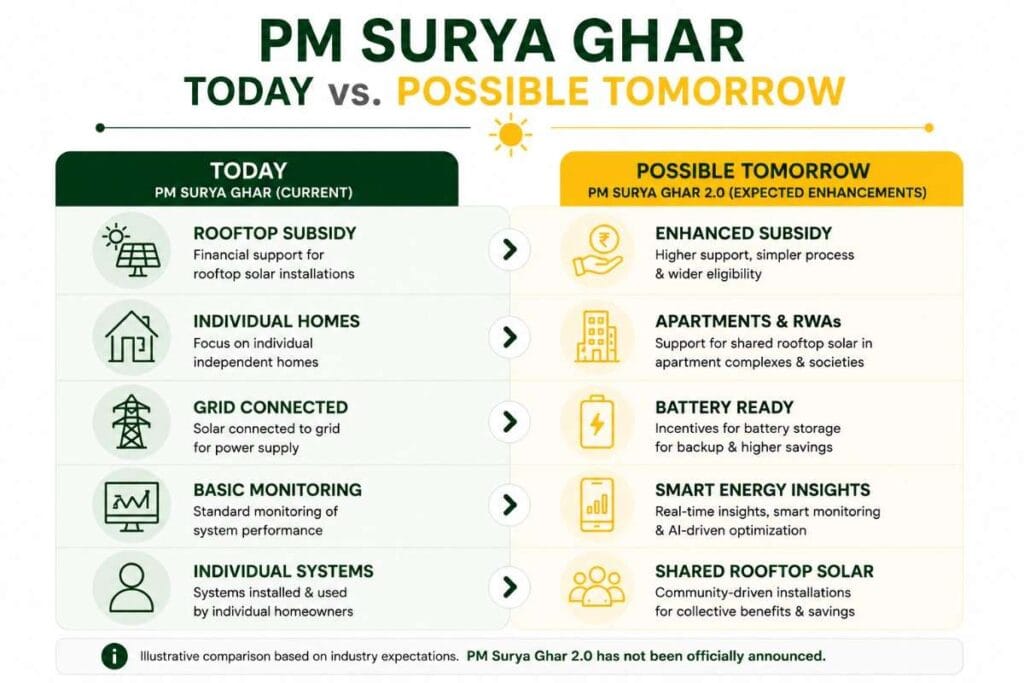
1. Enhanced Rooftop Solar Subsidy in India
One of the most anticipated changes is an increase to the rooftop solar subsidy scheme that India already has in place.
Instead of simply offering more money through subsidies, the new version may be about making things simpler, quicker, and reaching more homeowners.
Greater involvement at the state level can make it easier for approvals to be granted, making rooftop solar less of a hassle than it currently is.
Convenience can end up being just as important as subsidies for the homeowner.
2. Government Support for Battery Storage Subsidy
Solar panel installation addresses just a portion of the energy issue.
The absence of batteries will make most homes rely on the power grid after the sun sets.
This is the reason why many industry experts think that a battery storage subsidy program could be one of the most significant additions to future government programs.
Battery storage will allow homeowners to:
✔ Use solar electricity during evenings
✔ Reduce dependence during outages
✔ Improve energy self-consumption
✔ Lower grid consumption even further
3. Shared Rooftop Solar for Apartments
The lack of individual rooftops for millions of urban dwellers in India has been another huge missing link in this endeavor to adopt solar roofs.
In such cases, it is possible that sharing of rooftop solar energy may prove to be a breakthrough.
It is possible that the community housing societies could install their solar panel system on their shared rooftop and share the electricity produced from this panel among themselves in allotted quantities.
4. Smarter Energy Monitoring Using AI
Solar is not just about producing energy anymore.
Increasingly, home consumers look for mobile applications that will allow them to know how much energy is produced, consumed, saved, and the carbon footprint reduced.
In future government-assisted installations, it might help families use electricity efficiently rather than merely produce it.
This goes completely in line with India’s digitalization drive.
Any Hidden Opportunity Homeowners May Miss?
The future of residential rooftop solar is not only about the subsidies. It is about becoming energy independent in the long run.
As the electricity demand in India continues to grow, installing rooftop solar today without planning for tomorrow’s energy needs may result in undersized systems that require expensive upgrades later.
As a forward-thinking homeowner, you should already be asking:
- Can my system support battery expansion?
- Will it handle future EV charging?
- Can additional panels be added later?
- Is my inverter upgrade-ready?
While the government of India is planning for PM Surya Ghar 2.0, you should also plan with future scalability in mind rather than simply choosing the cheapest solution with the best subsidy available.
What Homeowners Should Do Right Now
Before the next phase, PM Surya Ghar 2.0 arrives, homeowners can already prepare by:
➜ Assess your rooftop’s solar potential.
➜ Review your average monthly electricity consumption.
➜ Choose high-quality components with future expansion capability.
➜ Work with a trusted EPC partner familiar with current subsidy processes.
➜ Stay informed about official government announcements instead of relying on speculation.
Preparation today can make it much easier to take advantage of future benefits when they become available.
Final Thoughts
India’s rooftop solar journey is clearly entering a more mature phase. While PM Surya Ghar 2.0 remains an anticipated evolution, the direction by MNRE indicates smarter residential solar facilities.
So, for homeowners, the real opportunity is not only securing the subsidy. It is investing in an energy solution that continues to deliver value for decades.
If you are planning to switch to solar, now is the ideal time to evaluate your energy needs. Connect with SolarEssentials to assess your home’s solar potential, understand the latest subsidy options, and design a scalable solution that keeps your electricity costs low for years to come.
Frequently Asked Questions (FAQs)
What is PM Surya Ghar Muft Bijli Yojana?
PM Surya Ghar Muft Bijli Yojana is a program launched by the Government of India that helps in the installation of solar roofs among selected households with the help of financial subsidies. This scheme will assist households in saving money on electricity bills.
What is PM Surya Ghar 2.0?
The phrase PM Surya Ghar 2.0 is an informal way to refer to the possible next step or development of the already existing scheme PM Surya Ghar. “PM Surya Ghar 2.0” usually implies certain improvements in policy that might include wider subsidies, battery installation support, and apartment access.
Is PM Surya Ghar 2.0 an official scheme?
No. As of now, there is no official announcement of any scheme by the Indian government by the name of PM Surya Ghar 2.0. The discussion about the same is speculative in nature.
Will PM Surya Ghar 2.0 include battery storage?
PM Surya Ghar 2.0 is still in its proposal phase. So, there is no official announcement of what it will include. However, several reports and experts in the industry expect that future policies for rooftop solar will involve battery storage in order to allow customers to store solar power generated in excess.
Can apartment owners benefit from PM Surya Ghar 2.0?
Although nothing is officially said about it, future policies can possibly provide more incentives for the installation of solar in apartments through communal or shared solar rooftops, which will allow residents of apartments to engage in rooftop solar activities.
What is shared rooftop solar?
The shared rooftop solar concept involves using one common solar panel system that is installed on the housing complex rooftop. The electricity generated is then distributed among participating residents based on predefined arrangements.
Will subsidies change in PM Surya Ghar 2.0?
No official information has been released regarding any modifications to the subsidies. Future modifications, should they be announced, may relate to increased eligibility, simpler application procedures, or support for technologies such as battery storage.
Should I wait for PM Surya Ghar 2.0 before installing solar?
No need to wait for that either. If you have high electricity bills, then setting up solar power on your roof through the existing plan will help you save money right away. A forward-looking system will also be helpful if new technology emerges.
How does rooftop solar reduce electricity bills?
Photovoltaic cells on the rooftop produce electricity using the sunlight available, thus cutting down the electricity consumption from the grid. The more houses use their own electricity, the more savings they make in their monthly electricity bill payments.
Where can I check the latest official scheme updates?
The best source for any up-to-date information is the official website of PM Surya Ghar: Muft Bijli Yojana and the Ministry of New and Renewable Energy (MNRE). The information available on both sites is genuine and accurate.