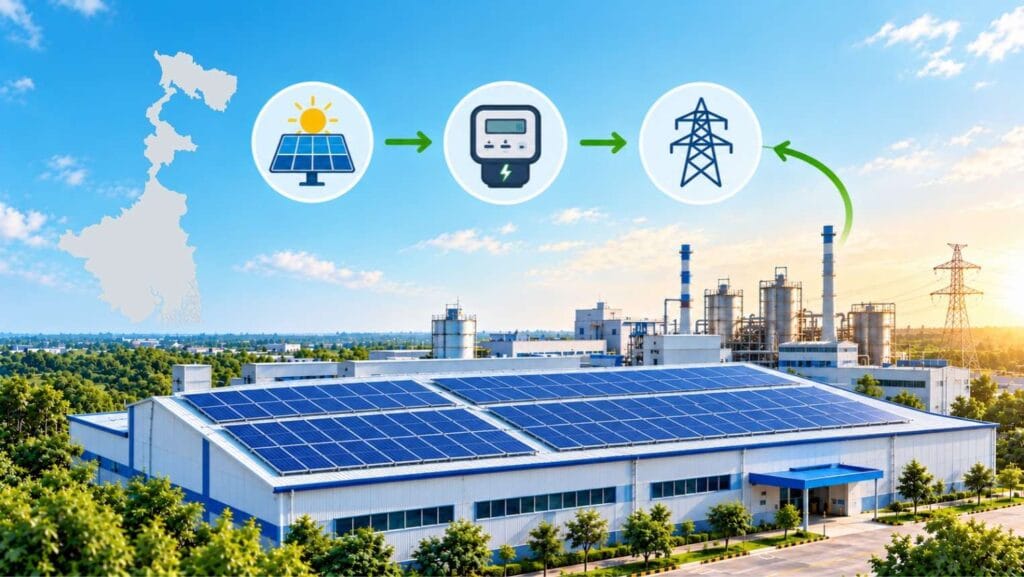
A factory can have a large rooftop, heavy daytime electricity consumption and a strong case for solar power… and still lose potential savings because its solar system is designed around the wrong billing arrangement.
Consider a manufacturing unit operating machinery throughout the day. Its electricity demand is substantial, and a 500 kW rooftop solar installation could help offset a significant portion of its consumption.
But what happens when the panels generate more electricity than the factory needs at a particular moment? Can the surplus be exported to the grid? Will the factory receive credits for it? And does a 500 kW installation qualify for net metering in West Bengal?
These are not minor technical questions. They can influence the financial viability of an industrial solar project. Read this guide till the end to know about West Bengal net metering for factories and practical issues.
What Is Net Metering for Factories in West Bengal?
Net metering refers to grid-tied rooftop solar technology that uses a legally accepted metering and billing process that accounts for the electricity produced by a solar power station and the electricity supplied by the grid. When the electricity production is more than the energy consumed by the factory, then it can be exported to the grid.
For industrial consumers, this can make rooftop solar more useful than simply generating power for immediate consumption.
However, having a 500 kW solar plant does not automatically mean a factory qualifies for net metering at that capacity. The applicable metering category, contract demand, connection conditions and distribution licensee all need to be checked before the project is finalised.
West Bengal Net Metering Regulations 2025: What Factories Need to Know
The West Bengal Electricity Regulatory Commission (WBERC) notified the Grid Interactive Rooftop Solar Photovoltaic System for Prosumers Regulations, 2025 on 31 July 2025. The framework addresses grid-connected rooftop solar systems and provides for net metering, net billing and gross metering arrangements.
But the question is…
Is 500 kW solar eligible for net metering in West Bengal?
The solar power project of 500 kW on the rooftop is required to be reviewed for eligibility. The pertinent threshold capacity, the contracted load or the sanctioned load of the factory, and other criteria set out by the distribution licensee should be taken into account.
Before committing to equipment procurement, confirm these points:
– The maximum solar capacity permitted under the applicable metering category.
– The factory’s recorded contract demand or sanctioned load and supply voltage.
– The technical feasibility of connecting the proposed solar plant to the distribution network.
– Whether net metering, net billing or gross metering is the appropriate permitted arrangement.
For authoritative reference, see the WBERC regulations and WBSEDCL’s solar regulations and orders.
How Does WBSEDCL Net Metering Work for Industrial Consumers?
For factories getting their power from the West Bengal State Electricity Distribution Company Limited (WBSEDCL), the procedure includes the eligibility criteria as well as technical approval of the project. The solar system to be installed should be evaluated based on the factory’s connection to electricity and the relevant regulations for grid interactivity.
Consider an example of a factory using 2,000 kWh of electricity in a single working day and producing 1,500 kWh of electricity through its rooftop solar system. Out of this amount, if 1,200 kWh of energy is used by the factory itself, then 300 kWh can be exported.
The factory still draws electricity from the grid when solar generation falls short. The way the exported 300 kWh is credited or settled depends on the approved metering arrangement; it should not automatically be treated as a one-for-one reduction in the bill.
Net Billing vs Net Metering in West Bengal
Choosing the right billing arrangement is one of the most important decisions in a factory rooftop solar project. The difference affects how exported electricity is valued, not merely how the meter records it.
Net Billing
Electricity drawn from the grid is billed under the applicable retail tariff, while exported solar electricity receives a credit based on the applicable feed-in tariff and agreement. The value of an exported unit may differ from the cost of an imported unit.
Net Metering
Imported and exported electricity are accounted for under the approved net-metering mechanism. It can be attractive where a factory consumes a substantial share of the power it generates, but eligibility and settlement rules must be checked.
Gross Metering
Solar generation and electricity consumption are accounted for separately. The generated electricity is settled under the applicable feed-in tariff, while grid consumption is billed separately under the applicable tariff.
Which Arrangement Is Better for a 500 kW Factory?
There is no universal winner. A factory that consumes most of its solar generation during production hours may benefit from maximising direct consumption, regardless of the export-credit mechanism. A facility with substantial surplus generation needs to examine export settlement more closely.
The better approach is to compare expected bill savings under each permitted arrangement using the factory’s actual load profile and the applicable tariff, not a generic solar savings estimate.
WBSEDCL Solar Application Process for Factories
Here is a practical overview of the WBSEDCL solar application process.
Step 1: Review the existing electricity connection
Collect the latest electricity bills and confirm the consumer category, consumer ID, sanctioned load or contract demand, supply voltage and connection details.
Step 2: Assess the proposed solar capacity
Review the roof area, structural suitability, electricity consumption profile and expected solar generation. Check whether the proposed 500 kW capacity fits the applicable metering category and connection conditions.
Step 3: Select the metering arrangement
Compare net metering, net billing and gross metering based on eligibility, expected self-consumption and the applicable export-credit mechanism.
Step 4: Submit the solar application
Follow the current procedure published by WBSEDCL and provide the required consumer, technical and project information. Check the latest forms and submission route on the official WBSEDCL solar regulations page.
Step 5: Complete technical scrutiny and installation
Proceed according to the applicable approval and connectivity requirements. The project may require technical checks relating to the grid connection, protection systems, metering and network capacity.
Step 6: Complete inspection, metering and commissioning
Follow the distribution licensee’s requirements for testing, meter installation or configuration, agreements and final commissioning. Confirm that the approved billing arrangement is reflected in the agreement before treating the system as operational.
Practical Note: The exact documents, fees, processing steps and approval requirements depend on the current procedure and the individual connection. Treat this as a planning overview rather than a substitute for the applicable WBSEDCL procedure.
The Overlooked Part of Factory Rooftop Solar West Bengal
Here is where many industrial solar proposals fall short: they focus on how many panels fit on the roof instead of how the electricity will actually be used.
Before finalising the project, ask your solar partner to prepare a consumption-led assessment that answers five questions:
- How much solar electricity will the factory consume directly?
- How much surplus generation is expected in different seasons?
- What export-credit value applies under the proposed metering arrangement?
- Is the full proposed capacity permissible under the applicable regulations and contract demand?
- How do the projected savings change if the plant is sized below 500 kW?
Is Your Factory in West Bengal Ready for Rooftop Solar?
A successful project begins with the right technical and regulatory assessment. Before choosing the system size or making an investment commitment, make sure the proposed installation aligns with your factory’s electricity demand, operating schedule, roof conditions and applicable metering rules.
With the details discussed above, hope it becomes much easier to compare project costs, estimate realistic savings and decide whether a 500 kW installation is the right fit.
Planning a factory rooftop solar project in West Bengal? Work with an experienced solar EPC partner to assess your site, electricity consumption, grid-connection requirements and potential savings before finalising the system capacity. Book your consultation with SolarEssentials today!
Frequently Asked Questions (FAQs)
What is the net metering limit for factories in West Bengal?
Under the current WBERC framework, net metering is available up to 500 kW or the consumer’s sanctioned load/contract demand, whichever is lower. Therefore, a factory cannot automatically claim net metering for a 500 kW system simply because its proposed plant is 500 kW.
Can industrial consumers with more than 500 kW get net metering in West Bengal?
Generally, no. The 2025 framework limits net metering to 500 kW or the applicable sanctioned load/contract demand, whichever is lower. For larger systems, eligible consumers can consider net billing or gross metering, subject to the applicable requirements.
What is the difference between net metering and net billing in West Bengal?
With net metering, imported and exported electricity are adjusted in the applicable energy accounting. Under net billing, electricity imported from the grid is valued at the applicable retail tariff, while exported solar electricity is credited using the applicable feed-in tariff.
How do I apply for net metering through WBSEDCL?
Applications are submitted through the WBSEDCL online solar application facility under its current Procedure-C (2025). The applicant provides the consumer and proposed solar-system details, after which WBSEDCL carries out the applicable eligibility and technical-feasibility process.
Is a feasibility study required for all factory solar systems in West Bengal?
No. Under the 2025 regulations, systems up to 10 kW do not require the technical-feasibility process. For systems above 10 kW, the distribution licensee must conduct the technical feasibility study within 15 days and communicate the outcome and clearance within 20 days of application.
What documents are needed for a WBSEDCL net metering application?
The application requires details such as the consumer number/ID, consumer category, sanctioned load or contract demand, proposed solar capacity and property/ownership information. Additional installation, fitness and compliance certificates are required during the commissioning stage, depending on the system and connection.
Can a factory install solar larger than its sanctioned load under net metering?
Generally, no. Under the current framework, the total rooftop solar capacity cannot exceed the applicable sanctioned load or contract demand, and net metering is additionally subject to the 500 kW ceiling. Specific regulatory exceptions may apply to certain government-funded projects or schemes.
How long does WBSEDCL take to approve a net metering application?
For systems above 10 kW, WBSEDCL’s current procedure provides 15 days for technical feasibility and 20 days for communicating the feasibility outcome, quotation and go-ahead clearance. After installation and submission of the required certificate, connectivity, agreement, meter installation and commissioning follow their prescribed timelines.
Do factories in Kolkata under CESC follow the same net metering rules?
They follow the WBERC 2025 regulatory framework, but CESC has its own implementation procedure. CESC currently states that net metering is available from 1 kW up to 500 kW or the applicable contract demand/agreemental load, whichever is lower, while net billing and gross metering have their own eligibility provisions.
Can net metering help reduce my factory’s electricity bill in West Bengal?
Yes. Solar generation can offset eligible grid electricity consumption, reducing the energy cost component of the bill. However, fixed charges, demand charges and other applicable charges may still remain, so actual savings depend on the factory’s load profile, solar generation and approved metering arrangement.