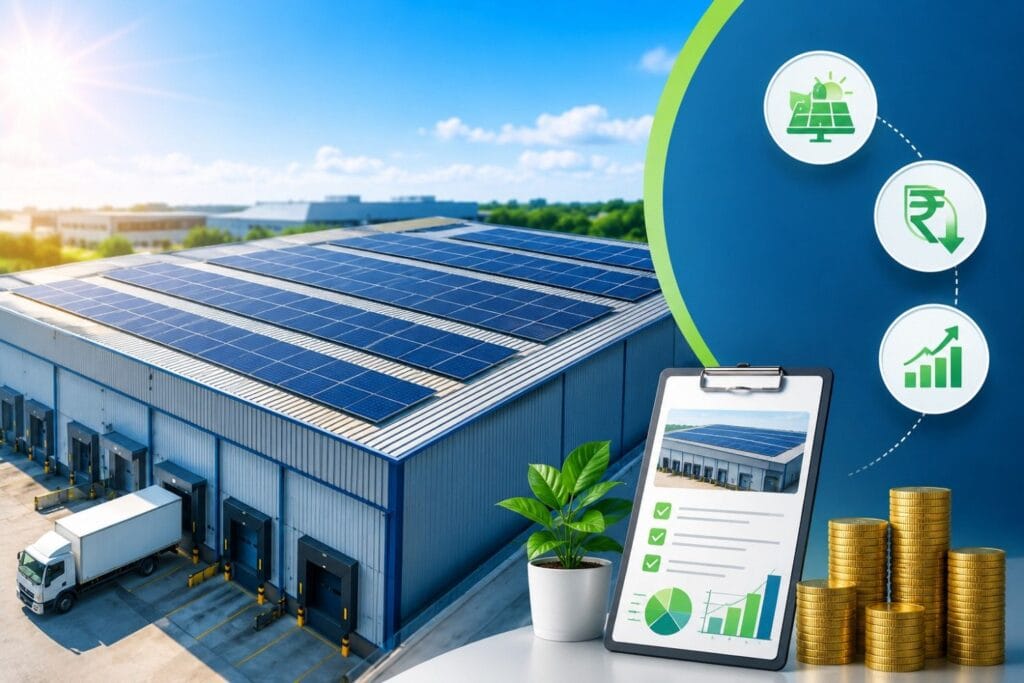
Modern warehouses operate smart supply chains with automated equipment and massive refrigeration units, which require a constant power supply.
So, clearly, the monthly electricity consumption continues to rise. However, warehouses have one of the largest unused commercial rooftops that has the potential to generate electricity every single day!
In fact, leading logistics centers across India are seeing 60 to 70% electricity cost savings. What are you waiting for?
Let’s understand the detailed process of warehouse solar installation, costs, benefits, ROI, and tax facilities.
Why Warehouses Are Perfect for Commercial Solar Installation
Electricity is a massive requirement for warehouses. But there is one thing about warehouses that makes them unique: a lot of roof space.
In contrast to commercial offices and residential buildings that have HVAC systems and other obstructions, a warehouse roof is spacious and gets enough sunlight throughout the day.
Hence, a warehouse roof solar system is considered one of the best commercial solar systems.
But why do warehouses require a significant amount of electricity?
- LED lighting
- Material handling equipment
- Conveyor systems
- HVAC and ventilation
- Cold storage
- Battery charging stations
- Office operations
Here’s the advantage. Most of these loads operate during daylight hours when a solar system generates most energy.
How Does a Warehouse Solar Installation Work?
A warehouse solar installation works by using large rooftop photovoltaic arrays that convert sunlight into electricity. See it here:
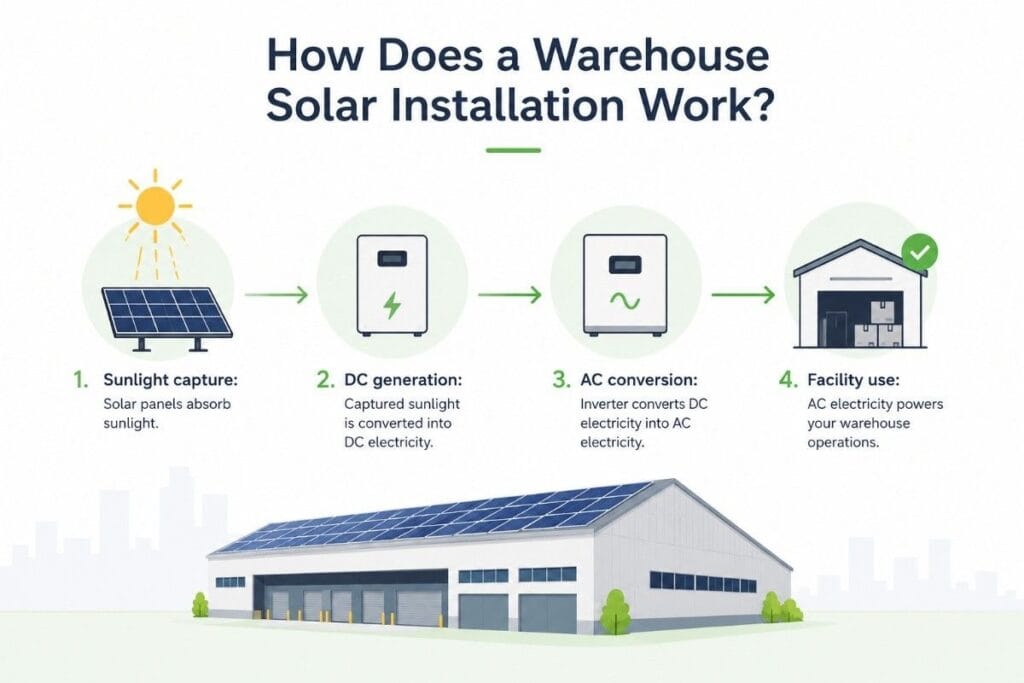
Capturing sunlight: Large commercial solar panels on the roof of the building absorb sunlight via silicon photovoltaic cells.
DC generation: The cells generate direct current (DC) electricity from sunlight.
AC conversion: Heavy-duty industrial solar inverters change the DC power into alternating current (AC) electricity. This is the standard form used by commercial equipment to operate seamlessly.
Facility use: The converted AC electricity routes straight into the warehouse’s main electricity panel to run lighting, ventilation, office loads, conveyor belts, or cold-storage refrigeration.
Key Benefits of Warehouse Rooftop Solar System
Massive Reduction in Electricity Bills
A well-designed rooftop solar power installation can cut down the reliance on electricity supplied through the grid, thus saving businesses millions in costs over the lifetime of the installation.
The cost of sunlight is not going to rise like that of fuel or electricity charges.
Faster Return on Investment
Commercial solar systems usually have good returns due to the high energy requirements for the warehouses during the daytime.
After the initial investment, all the other years will see reduced operating expenses.
Better Protection Against Rising Power Tariffs
Solar enables you to have some control over your energy prices through producing your own electricity and not being fully dependent on utility companies.
This brings about predictability in pricing.
Improved ESG & Sustainability Goals
Using solar power clearly reflects a commitment towards lowering carbon emissions while strengthening ESG reporting.
This could be a competitive edge for firms whose products are designed for exports.
Low Maintenance
Most businesses think that solar panels need regular maintenance.
That is not always true.
Good commercial systems have very little that moves in them and just need cleaning and periodic checks from time to time.
What Is Warehouse Solar Installation Cost in India
Wondering how much a warehouse solar installation costs?
In reality, there is no straight answer to this. The cost of rooftop solar installation depends on several critical factors such as:
- Total system capacity
- Roof size
- Roof type
- Electricity consumption
- Panel technology
- Inverter quality
- Structural requirements
- Installation complexity
Larger system installations offer more benefits, resulting in a lower cost per kilowatt compared to smaller installations. So, you should focus less on the upfront investment and more on the lifetime savings.
A professional solar EPC company conducts a site survey before providing a transparent cost proposal and financial analysis.
Is Your Warehouse Roof Suitable for Commercial Warehouse Solar Installation?
Now comes the real question… is your warehouse roof suitable for solar installation?
Even though most warehouses are excellent candidates for commercial solar installation, several factors are evaluated before installation:
- Roof condition
- Structural strength
- Available shadow-free area
- Roof orientation
- Future expansion plans
- Existing rooftop equipment
Bottom Lines
In 2026, solar offers much more than just sustainability strength. It offers reduced electricity bills, long-term financial planning, and enhanced business competitiveness.
If your warehouse still has a useless rooftop, it’s time to transform it into an energy generation machine. Connect with SolarEssentials as your solar EPC company & know the GST & other facilities.
Frequently Asked Questions (FAQs)
What is warehouse solar installation?
Installing a warehouse solar system refers to the installation of a solar photovoltaic (PV) system on a warehouse roof to provide renewable energy. This energy is harnessed for use in warehouse activities, making less use of electricity from the power grid.
How much does warehouse solar installation cost in India?
These include, among others, the capacity of the system, size of the roof, quality of panels, etc. The most appropriate and accurate way of knowing the cost of your project is having a comprehensive site survey conducted by an expert solar EPC firm.
What are the benefits of installing solar panels on warehouses?
In warehouses, solar panels assist in saving on electricity costs, becoming energy independent, avoiding increases in the cost of power, reducing carbon emissions, and increasing efficiency in terms of savings.
How much roof space is required for a warehouse solar system?
The roof space needed differs according to the size of the system and the efficiency of the panels. Typically, the roof space needed for one kilowatt is roughly 80 to 120 sq. ft.
How much electricity can a warehouse solar installation generate?
The production of electricity depends on the capacity of the system, its location, sunlight intensity, and climatic conditions. With standard Indian conditions, the daily generation of a 1 kW system could be 4 to 5 units of electricity.
What is the ROI of a warehouse solar installation?
The cost-effectiveness of solar power projects comes from the reduction in electricity bills for a few years. You need to consider the energy usage including the local electricity charges and the size of the system. The fact that solar panels usually serve for up to 25 years ensures continued benefits from reduced energy costs.
Can warehouses remain operational during a solar installation?
Yes. Experienced solar EPC contractors plan the installation in phases. This allows most warehouse activities to continue with minimal disruption to daily operations.
Are there government subsidies or tax benefits for warehouse solar installations?
As for central subsidy schemes, they usually cover residential rooftop PV systems. But there might be a possibility of using the scheme of rapid depreciation, state-based subsidies, or any other programs that can be applicable to commercial and industrial projects.
How long does it take to install a solar system on a warehouse?
The timing of installation will depend upon the size of the project and its construction needs. Commercial warehouse solar installations take between 4 and 12 weeks from the time of designing till completion of installation.
How do I choose the right solar EPC company for a warehouse solar installation?
Select an EPC company that has commercial project experience, engineering prowess, quality equipment, financial analysis, after-sales service, and has completed successful projects of warehouse/industrial solar installations in the past.