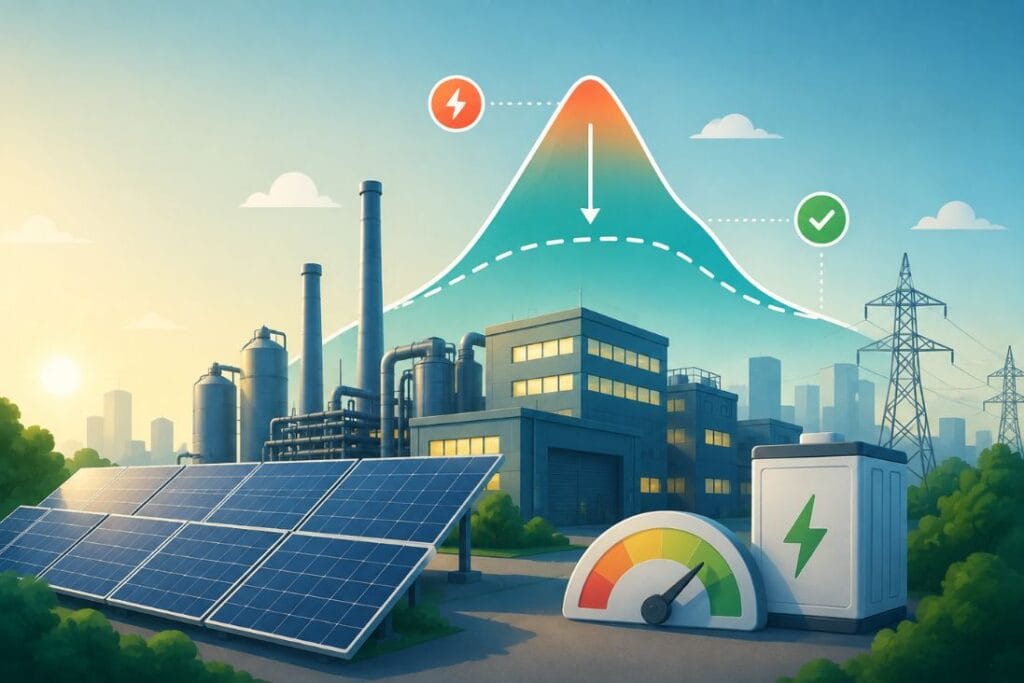
For many industrial and commercial businesses across India, the highest 15 minutes of extremely high electricity demand quietly inflate the entire electricity bill.
This is not always because the electricity usage is higher. In many cases, it is because your facility demands a large amount of power for just a few minutes.
But as energy prices continue to rise and industries push for greater efficiency, reducing energy consumption isn’t a practical option. That’s why peak shaving becomes a game-changer.
Let’s learn what it is, why it matters for industries in India, how it works, and which industries benefit the most.
What Is Peak Shaving?
Peak shaving is a strategic energy management technique aimed at lowering the peak level of electricity consumption during certain time intervals.
Instead of relying on the grid for all the power needed to meet the peak demand, companies will make use of other power sources, such as a battery energy storage system (BESS), photovoltaic panels with storage, or a backup power supply.
Think of peak shaving as traffic management.
Instead of allowing every vehicle onto the highway at the same time, traffic is intelligently distributed to avoid congestion. Peak shaving for industries works similarly by distributing electricity demand more efficiently.
The result is lower demand charges, improved energy efficiency, and greater control over operating costs.
Why Does Peak Load Management Matter?
Many businesses still focus only on electricity consumption measured in kilowatt-hours (kWh). However, industrial electricity bills often have another major component… Demand Charges.
These charges are based on the highest amount of power (kW) your facility draws during the billing cycle. Sometimes it is measured over just a 15-minute or 30-minute interval.
For example:
When multiple heavy machines start simultaneously, your facility’s energy demand can spike dramatically. Even if that spike lasts only a few minutes, your electricity provider may calculate demand charges based on that single highest reading.
That’s why two factories with similar monthly energy consumption can end up paying very different electricity bills.
How Does Peak Shaving for Industries Work?
Peak Shaving is the process in which high-demand periods are detected, and a portion of that demand is met from another energy source, usually a BESS (Battery Energy Storage System).
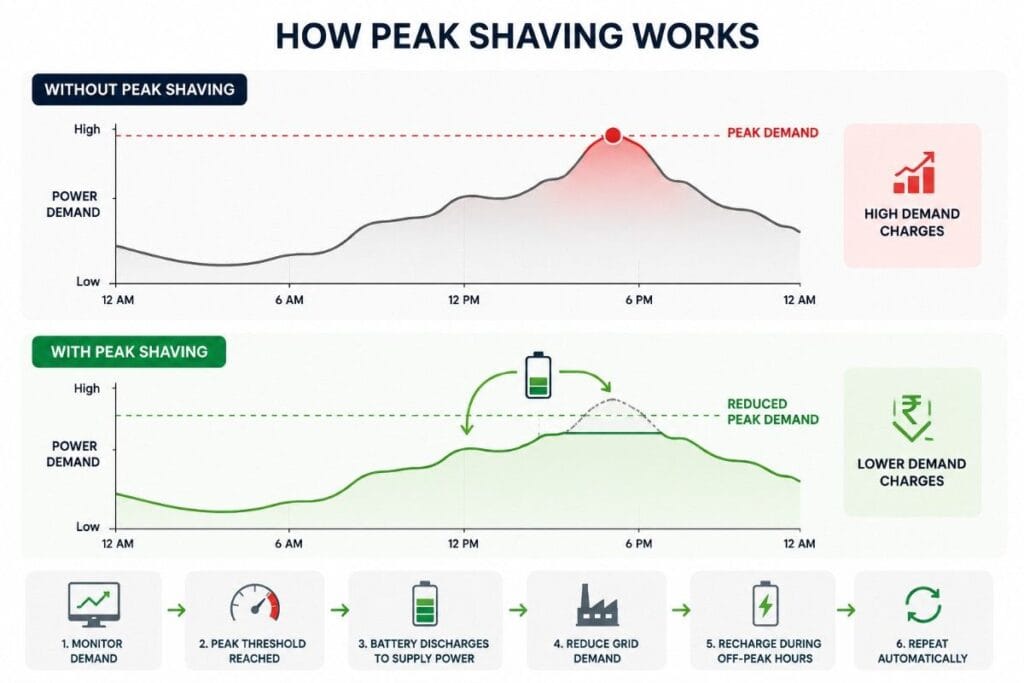
1.Monitor Energy Consumption
The energy management system continuously monitors the facility’s electricity demand and identifies changing load patterns.2. Identify Peak Demand Periods
When electricity usage approaches a predefined peak, the system recognizes that a demand spike is imminent.3. Activate Battery Storage
The battery system automatically supplies stored electricity to the facility, reducing the amount of power being drawn from the grid.4. Reduce Grid Demand
By supplementing grid power with stored energy, the facility keeps its maximum demand below the targeted threshold, helping reduce demand charges.5. Recharge the Battery
Once demand falls, the battery can recharge during off-peak hours or using excess electricity generated by a rooftop solar system.6. Repeat Automatically
The energy management system continuously monitors demand and repeats the process whenever another peak occurs, enabling effective peak load management without disrupting industrial operations.Peak Shaving Battery Storage: The Smart Solution for Industrial Energy Cost Reduction
Earlier, industries often relied on diesel generators to manage peak loads.
But today, peak shaving battery storage has become the preferred alternative for businesses looking to reduce costs while meeting sustainability goals.
Why Batteries Are Becoming the Preferred Choice
Battery Energy Storage Systems (BESS) respond almost instantly. Also, they require less maintenance than diesel generators and produce no on-site emissions.
Batteries can integrate seamlessly with rooftop solar, allowing industries to maximize self-generated renewable energy while reducing dependence on the grid.
More importantly, battery technology is becoming more affordable. Because businesses have discovered that energy storage is not just a backup system anymore. It is an active cost-saving asset.
Industries That Benefit Most from Reduce Demand Charges
Manufacturing Plants
Heavy machinery often creates sudden energy demand spikes during production shifts. Peak shaving keeps those demands under control without interrupting operations.Food Processing Units
Large refrigeration systems, compressors, and production equipment frequently operate together. This increases the peak demand, but battery storage helps balance these loads efficiently.Warehouses & Logistics
Automated equipment, HVAC systems, and electric vehicle charging stations can create unpredictable demand peaks throughout the day. Managing these peaks improves overall energy efficiency.Commercial Buildings
Large office complexes, hospitals, hotels, and shopping malls experience demand spikes from centralized air-conditioning systems during peak occupancy hours. Battery storage helps stabilize these loads.Peak Shaving vs Load Shifting
People often confuse peak shaving and load shifting. Without understanding both, you can’t decide on a proper solution. Here’s a comparison:
Peak Shaving | Load Shifting |
Reduces maximum power demand | Moves electricity usage to another time |
Focuses on lowering demand charges | Focuses on reducing energy cost during expensive tariff periods |
Uses batteries during high demand | Reschedules operations where possible |
Maintains uninterrupted production | Requires flexible operational schedules |
Solar for Industrial Energy Cost Reduction
For factories, the use of solar energy goes beyond being simply a means of reducing reliance on grid electricity. With the integration of peak shaving and battery storage, it becomes a strategy for managing energy expenses.
How Solar + Battery Storage Reduce Industrial Energy Costs
✔ Generate solar power during the day
✔ Store excess solar energy
✔ Detect approaching peak demand
✔ Discharge stored energy
✔ Lower peak demand
✔ Optimize energy throughout the day
Partner with SolarEssentials for Smarter Energy Management
Every industrial facility indeed has a unique energy profile. This means there is no one-size-fits-all approach to peak shaving.
SolarEssentials helps commercial and industrial businesses design intelligent energy solutions that combine rooftop solar, Battery Energy Storage Systems (BESS), and advanced energy management technologies.
If you are looking to reduce demand charges and future-proof your business, our team is ready to help. Get in touch with SolarEssentials today for a customized energy assessment.