For organisations considering solar energy, one of the most important decisions is not only the system design or capacity but the commercial model under which the solar project will be implemented.
In India, most commercial and industrial solar projects are structured under two primary models: CAPEX and OPEX (also known as RESCO).
Both approaches allow businesses to benefit from solar power, but they differ in terms of ownership, financial structure, operational responsibility, and long-term economics. Understanding these differences is essential before making a solar investment decision.
Understanding the CAPEX Solar Model
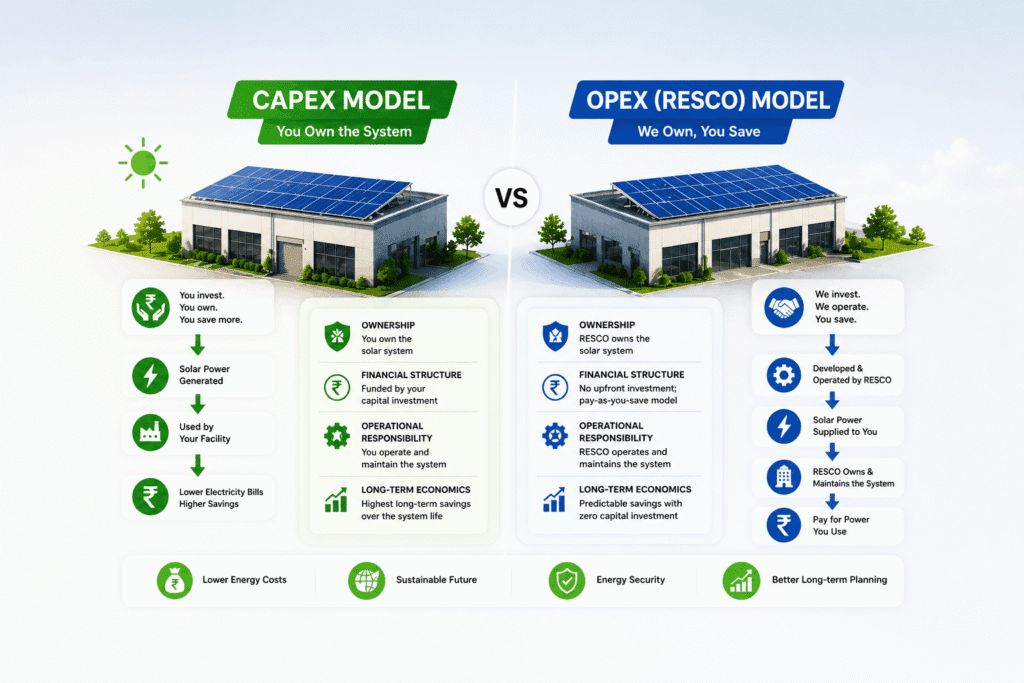
Under the CAPEX model, the organisation investing in solar owns the system from the beginning.
The business funds the solar installation as a capital investment, and the system becomes part of its infrastructure assets. The electricity generated by the solar plant is consumed directly by the facility, reducing the amount of power purchased from the grid.
Because the organisation owns the system, it receives the full financial benefit of the electricity generated. Over the lifetime of the solar plant, this typically results in the highest long-term savings compared to other solar structures.
The CAPEX model is commonly adopted by organisations that have the ability to allocate capital toward infrastructure investments and want full control over their energy assets.
Key advantages of the CAPEX model
- Maximum long-term reduction in electricity costs
- Full ownership of the solar infrastructure
- Greater control over system operations and performance
- Eligibility for depreciation benefits where applicable
- Long-term energy cost predictability
However, CAPEX projects require upfront investment and careful technical planning to ensure the system is correctly designed for the facility’s energy consumption.
Understanding the OPEX / RESCO Solar Model
The OPEX model, also known as the RESCO model (Renewable Energy Service Company), allows organisations to adopt solar power without making a capital investment.
In this structure, a solar developer finances, owns, and operates the solar system. The organisation hosting the system purchases the electricity generated through a long-term power purchase agreement (PPA) at a predetermined tariff.
The electricity price is typically lower than the prevailing grid tariff, allowing the organisation to reduce electricity costs without investing in the infrastructure.
Because the system is owned by the developer, operational responsibility — including maintenance and performance management — generally remains with the system owner.
Key advantages of the OPEX / RESCO model
- No upfront capital investment
- Immediate electricity cost reduction
- Predictable power pricing through long-term agreements
- Operational responsibility handled by the project owner
- Ability to adopt solar while preserving capital for core business operations
This model is particularly attractive for organisations that prefer to reduce operating costs without deploying capital expenditure.
CAPEX vs OPEX: Key Differences
While both models enable organisations to adopt solar energy, they differ in several important ways.
In a CAPEX project, the organisation owns the solar system and receives the full financial benefit of the electricity produced. The savings are typically higher over the long term, but the project requires upfront investment.
In an OPEX project, the organisation does not own the system. Instead, it purchases electricity generated by the solar plant at a lower tariff under a long-term agreement. While savings begin immediately, the financial benefit is shared with the developer that owns the system.
From a financial perspective, CAPEX projects often deliver greater cumulative savings, whereas OPEX projects offer greater financial flexibility and lower initial commitment.
Choosing the Right Solar Model
The choice between CAPEX and OPEX depends on several factors, including:
- Capital availability and investment strategy
- Electricity consumption profile of the facility
- Long-term operational planning
- Risk preferences related to asset ownership
- Financial priorities of the organisation
There is no universal answer that suits every organisation. Each solar project must be evaluated individually based on technical feasibility and commercial considerations.
The Role of Proper Project Evaluation
Regardless of the model selected, successful solar adoption depends on careful planning and disciplined execution.
Factors such as system sizing, structural feasibility, electrical integration, regulatory approvals, and long-term maintenance all play a critical role in determining whether the project will perform as expected.
At SolarEssentials, every project begins with a detailed feasibility assessment that evaluates both the technical and commercial viability of the solar installation. The objective is not simply to install a system, but to ensure the chosen model aligns with the organisation’s energy strategy and long-term operational needs.
Solar as a Strategic Energy Decision
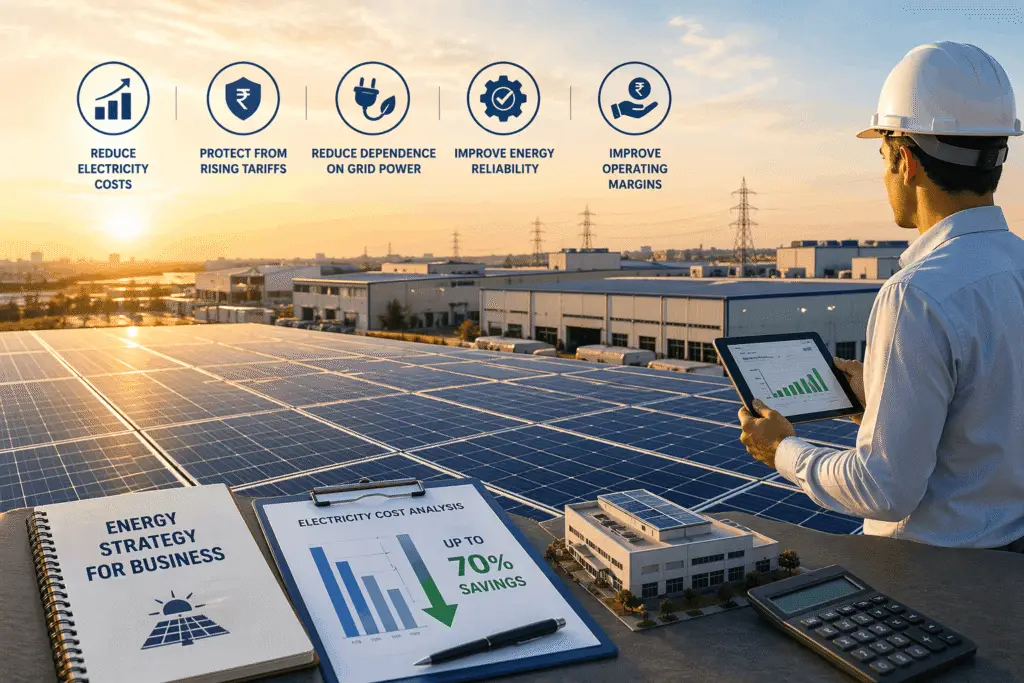
For many organisations, solar energy represents an opportunity to reduce electricity costs, improve energy predictability, and strengthen sustainability commitments.
Whether implemented through CAPEX or OPEX structures, solar power is increasingly becoming an integral part of how businesses manage their energy infrastructure.
The key is selecting the model that balances financial practicality, operational reliability, and long-term value.
When evaluated and executed correctly, solar energy can provide organisations with a dependable source of power and a more stable energy cost structure for decades to come.